Collective Action: Labor Activism in 21st Century Baltimore
The complicated dynamics between work, class, politics, and economics are threads that demand attention but are often too entangled to make sense of. Enter Collective Action, a 2024 Baltimore Museum of Industry exhibit that amplified the voices and visions of local labor activists from the 21st century. By using the visual tools employed by activists themselves–protest signs, painted banners, and street photography–the exhibit drove home that, no matter your industry or occupation, the fight for fair wages, equitable rights, and a sustainable future affects us all.
The Challenge
The exhibit’s setting was important and timely for two reasons. First, because the Museum of Industry is a place where people come to better understand what is meant by “work” in all its iterations, and second, because the city of Baltimore has been and continues to be a historic center of labor activism and organization.
From the beginning, we faced the dilemma of having a wealth of material to showcase but a small budget and space to work with. Designing the exhibit to have a grass-roots feel both solved for and amplified the impact of the exhibit in three ways: it kept the exhibit from feeling stuffy, polished, or corporate; it allowed us to lean into the use of affordable materials; and it helped create an environment that placed visitors in the center of the fight.
Project Vision
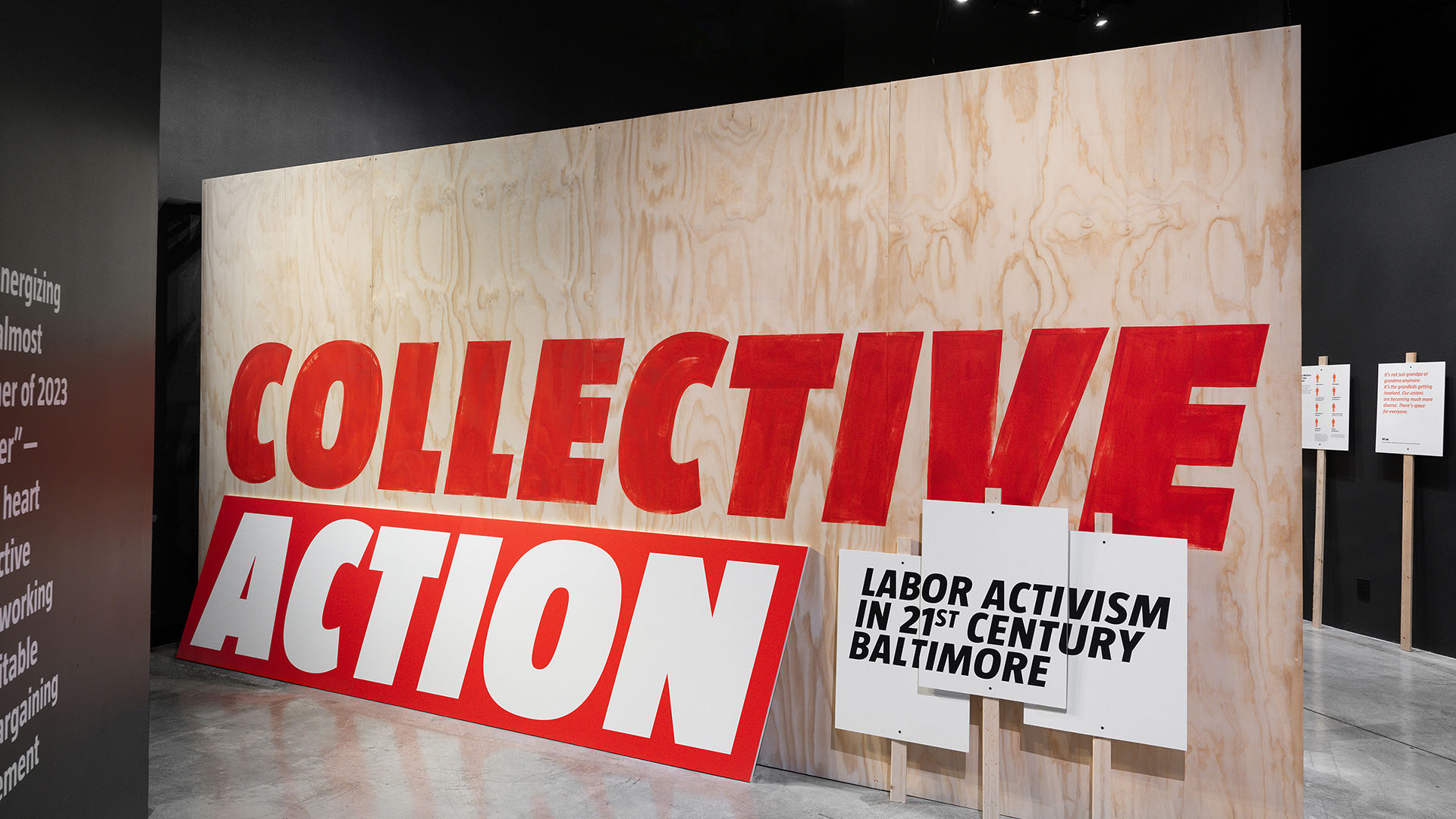
The power of the exhibit is in the immediacy of its presentation. At the entrance, an unvarnished plywood wall displayed the exhibit’s name with a punch of hand-painted letters for a do-it-yourself effect. The supplies’ simplicity was a deliberate choice to reflect the necessary, and often ingenious, resourcefulness of labor activists to draw attention to their cause. In the bottom right, a triptych of picket signs overlapped to complete the title. Once inside, the picket sign motif accompanied visitors and delivered key information throughout the space.
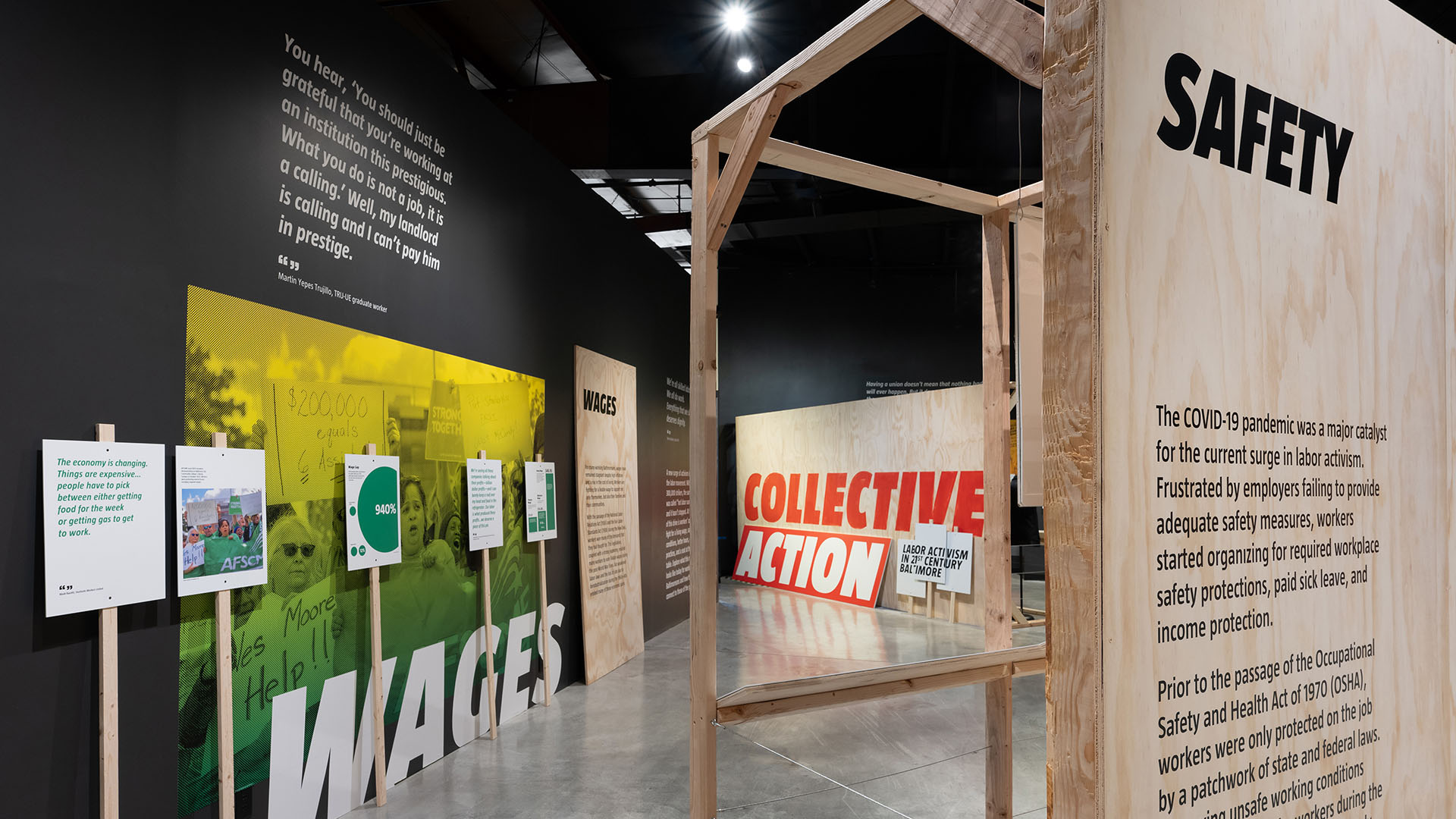
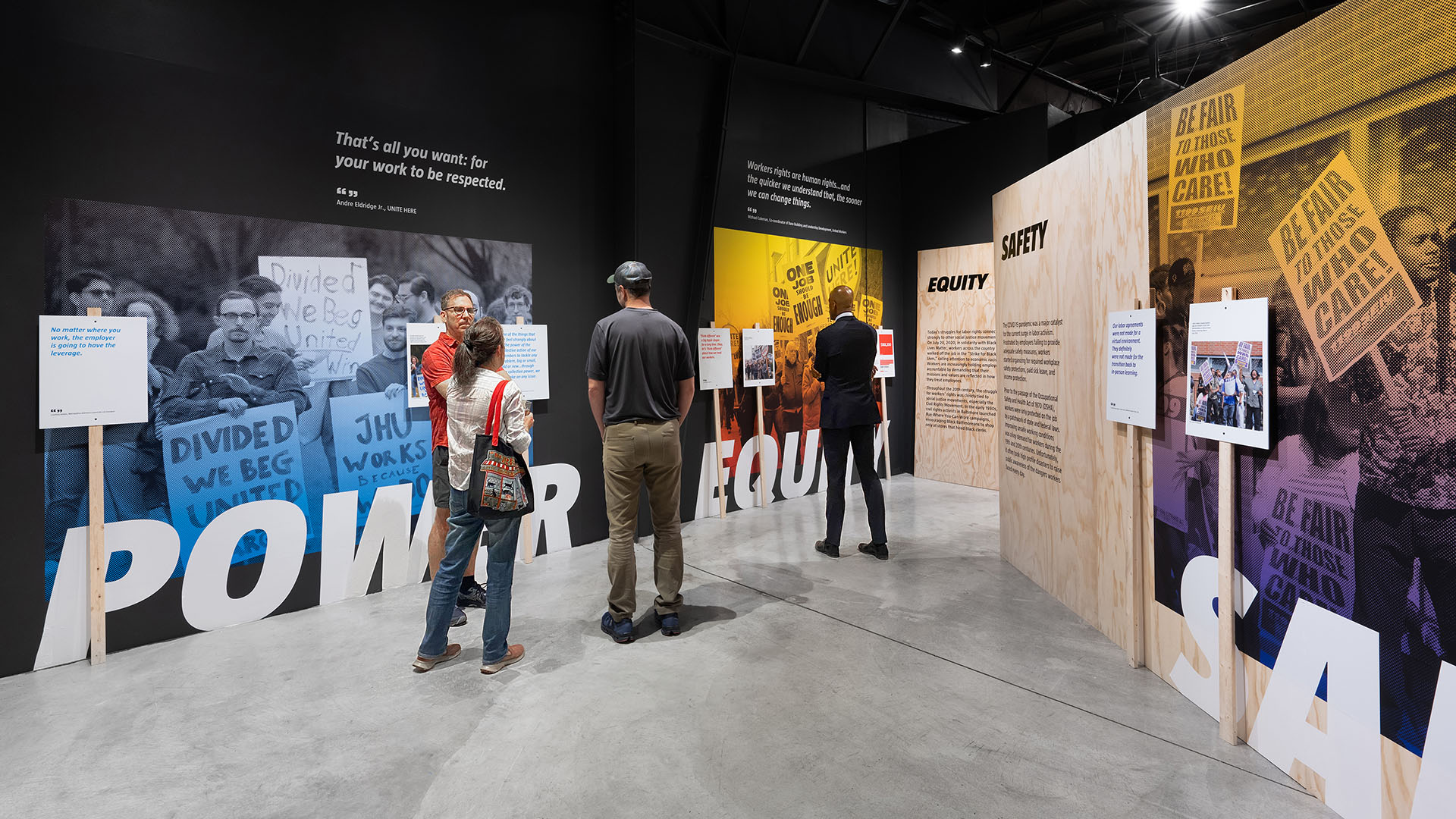
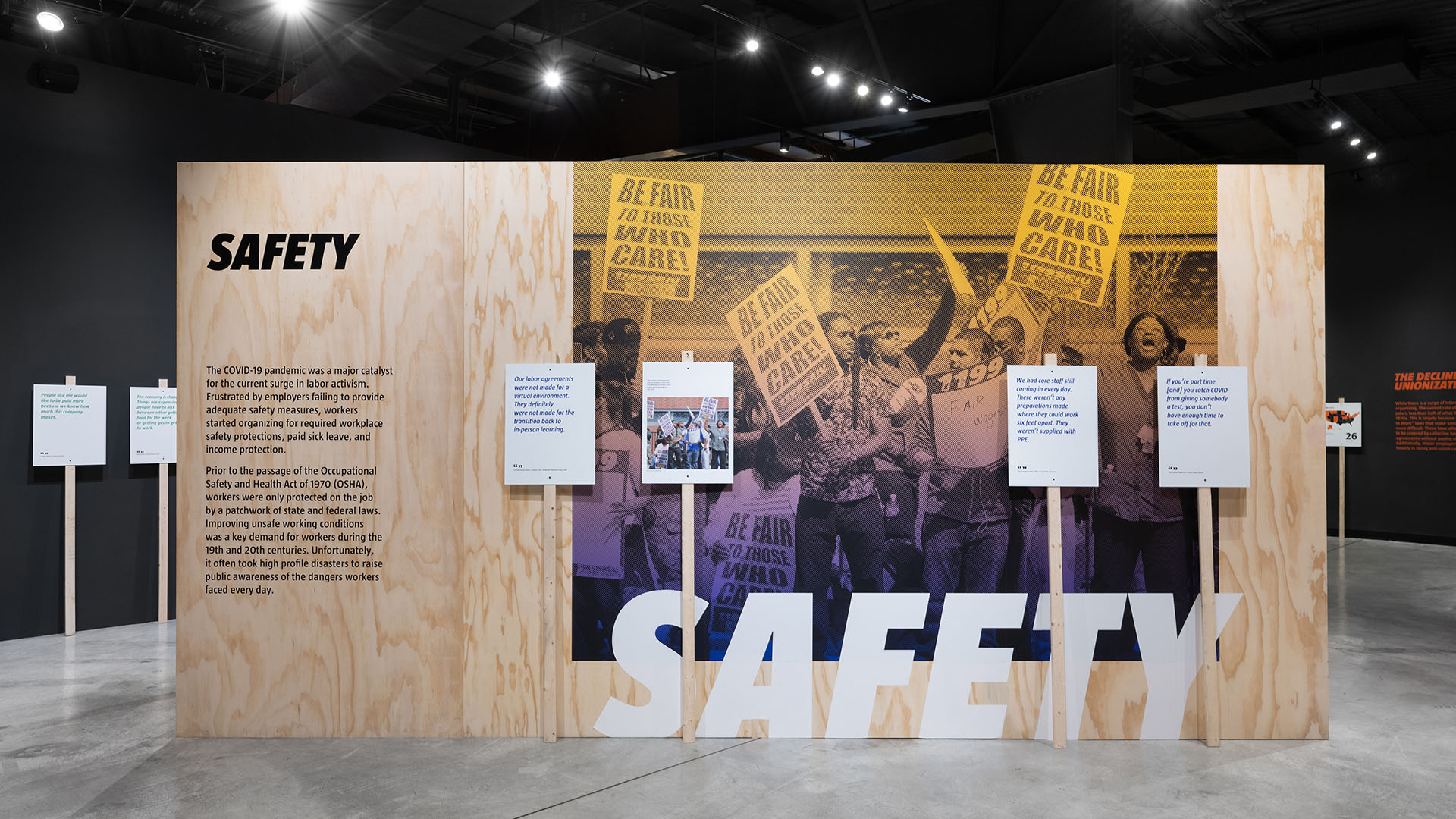
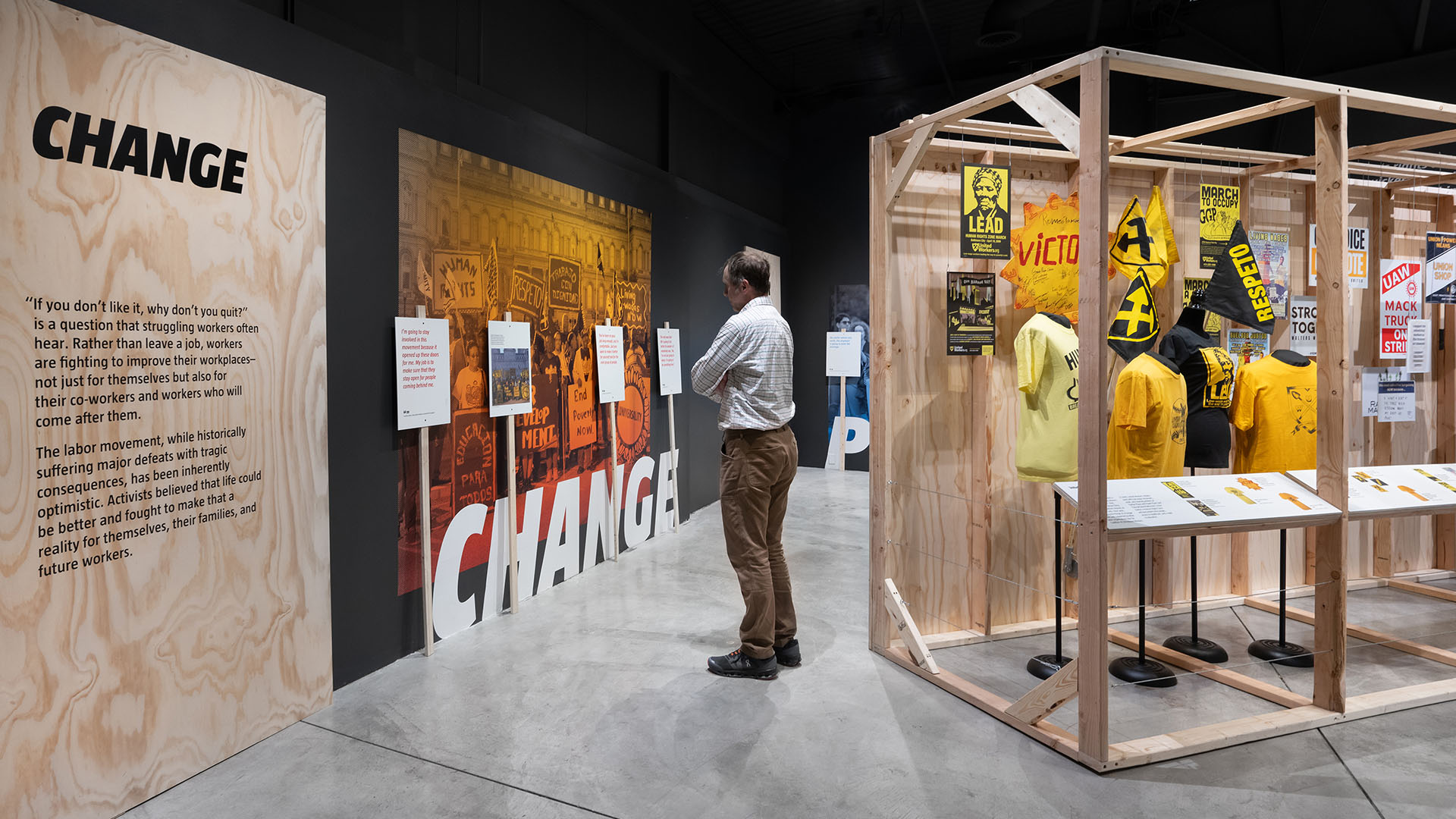
The exhibit focused on five themes: Wages, Equity, Power, Safety, and Change. Each section was anchored by a large wall mural, where photography was rendered in true-to-life scale, inviting visitors to stand in with the advocacy groups. Stylizing the imagery with a halftone pattern made it possible to scale low-quality and low-resolution photos captured by participants and observers to large sizes.
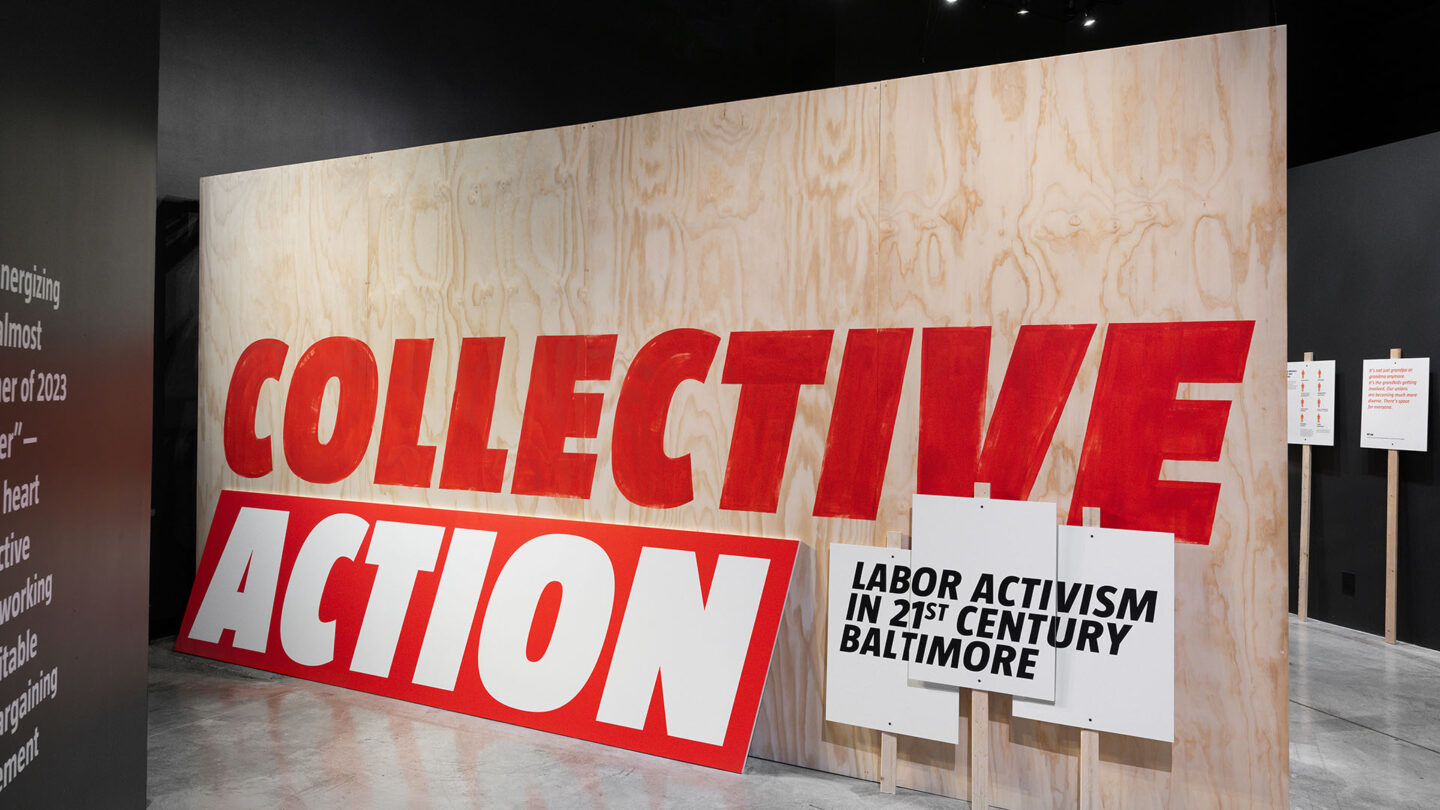
Labor’s roll-up-your-sleeves spirit was on immediate display at the entrance, where an unvarnished plywood wall with hand-painted lettering greeted visitors. Overlapping picket signs completed the exhibition’s title.
Vivian Marie Doering
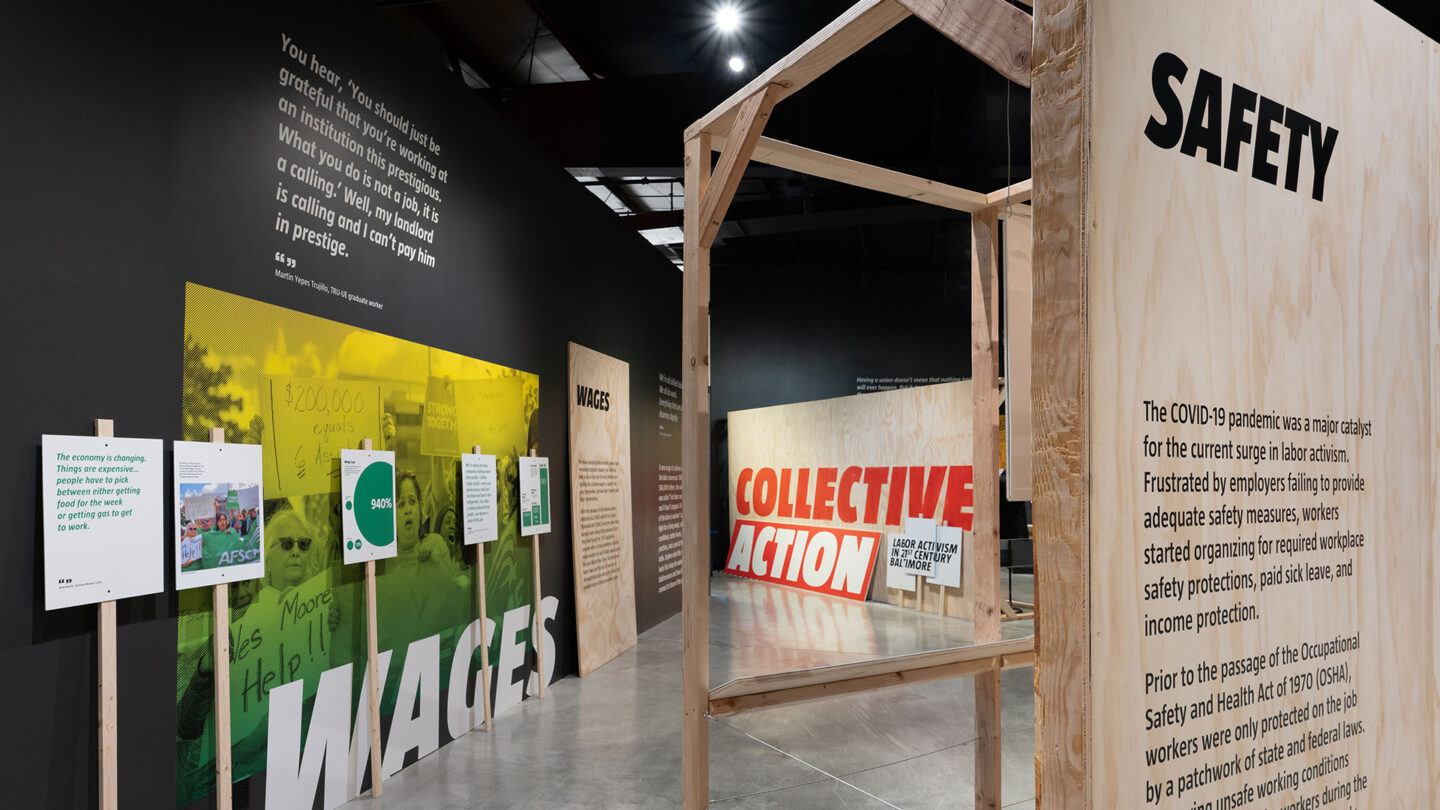
Voices and perspectives of real individuals were featured on protest signs lining the gallery walls. They spurred visitors on through the exhibit with key information and thought-provoking quotations.
Vivian Marie Doering
Design + Execution
We layered picket signs in front of the murals to break the barrier between the exhibit’s time-bound narrative and the visitor’s in-person experience; it shattered the illusion that this is a fight relegated to the past. Lined along the gallery walls, the signs were a vehicle for spotlighting the voices of many different workers, as each sign voiced the perspective of a real individual. Elsewhere, simplified data graphics emphasized the stark realities of working in the U.S.
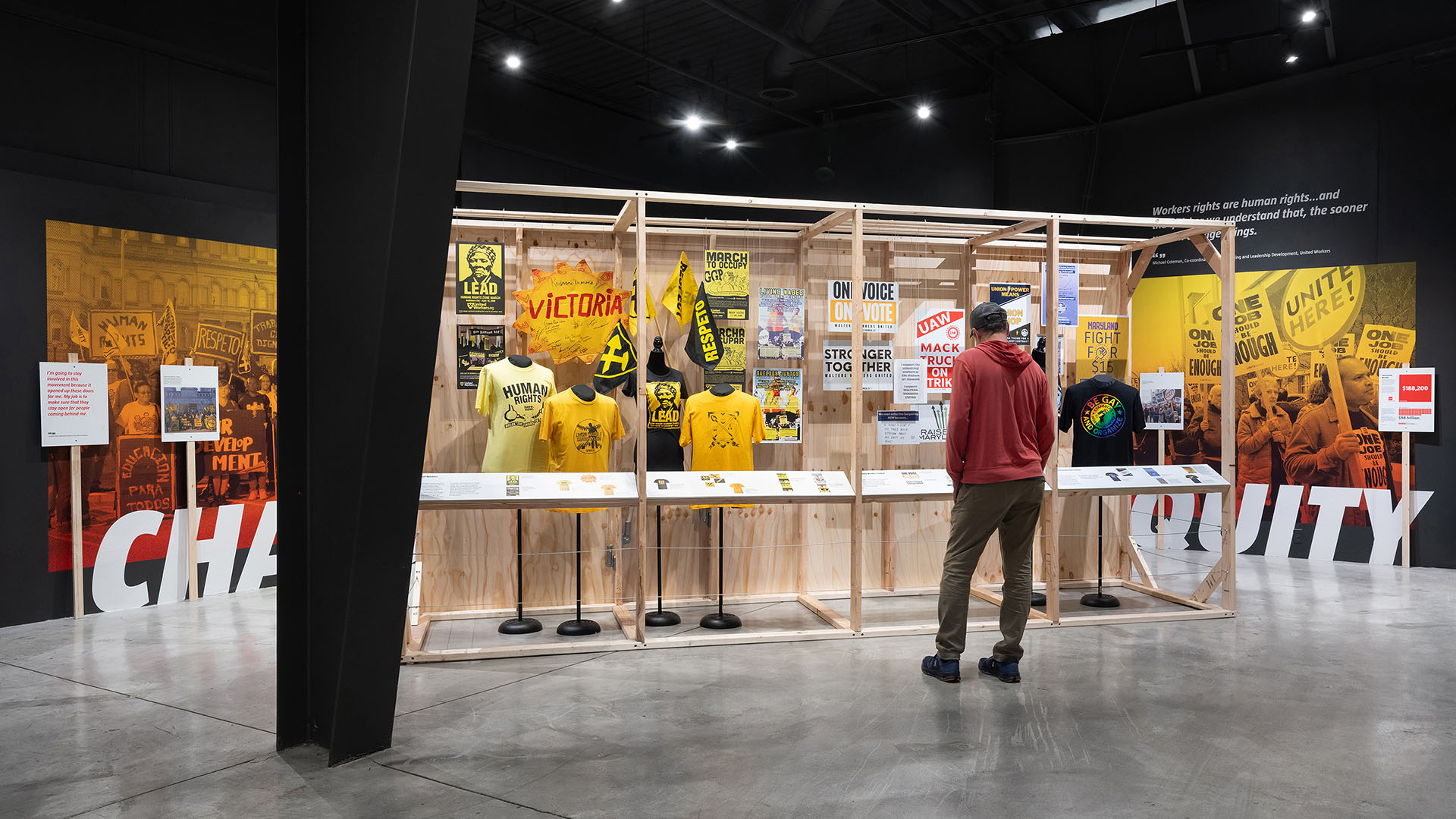
In the center of the exhibit, we built an open-air structure to house a collection of union and activist ephemera that reinforced the notion of strength in numbers. Paper artifacts were digitized and reproduced on recycled aluminum panels before being suspended in the structure with braided wire, resulting in a three-dimensional collage of slogans, organizations, and artifacts that felt like a resounding, self-contained rally.
A primer on unionization, affectionately named Unions 101, concluded the exhibition. It tracked the decline of unions across the country, despite the renewed need for workforce advocacy. Still, as Baltimore is home to the first Apple store and one of the first Starbucks to unionize, the city continues to push for change both locally and nationally. The exhibit was a snapshot of this tension between advocating for immediate personal welfare and greater public discourse.
The sense of urgency created by the Collective Action exhibit drove home why the fight for living wages, safe working conditions, better hours, and more equitable practices affects everyone, whether or not you are a union worker or Baltimore City resident. By showcasing the movement’s slogans, tools, and everyday heroes, it challenged visitors to consider if the messages featured were from voices relegated to the past, or if they are calls to action from the better angels of our future.
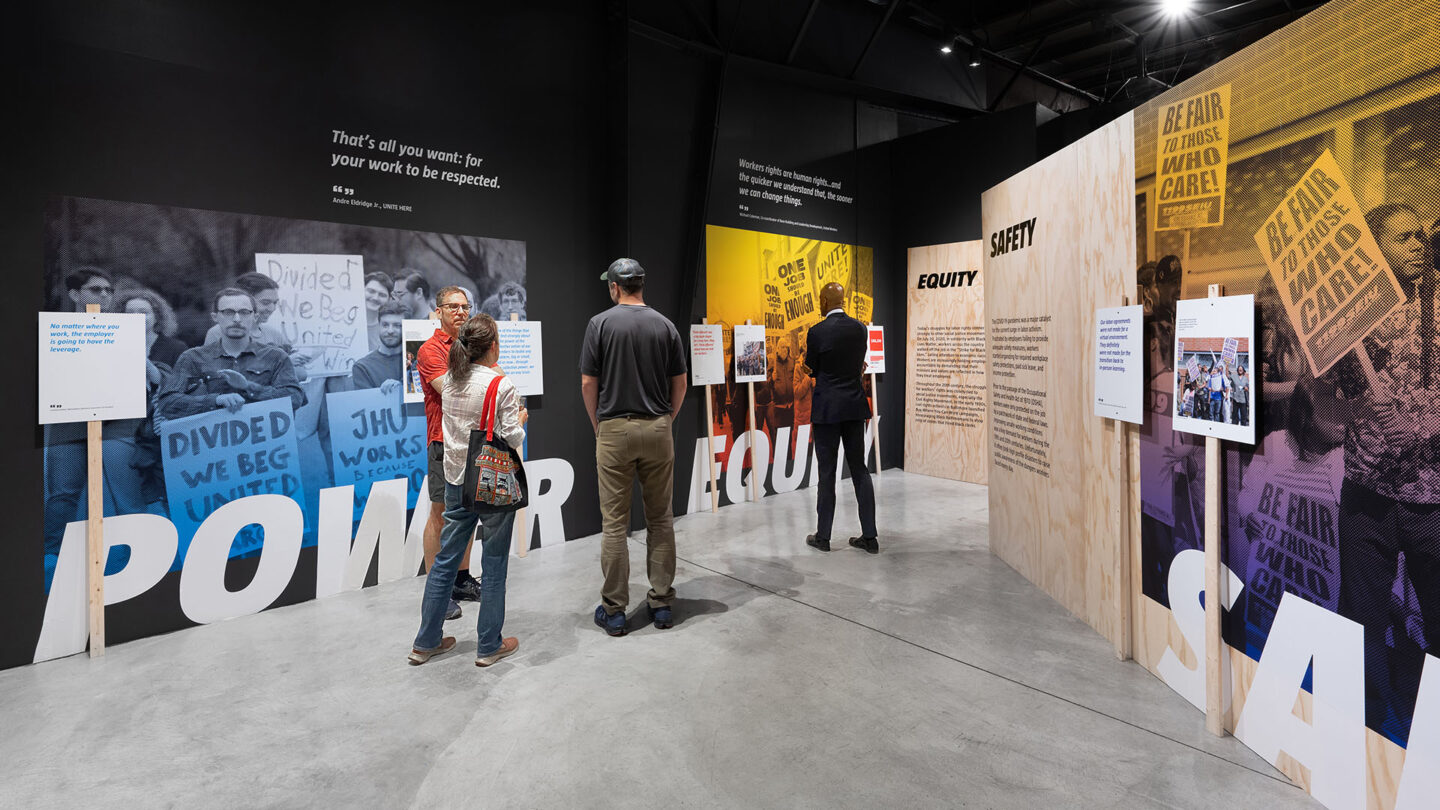
Each photograph was custom treated with a gradient background to match the featured labor organization’s color scheme.
Vivian Marie Doering
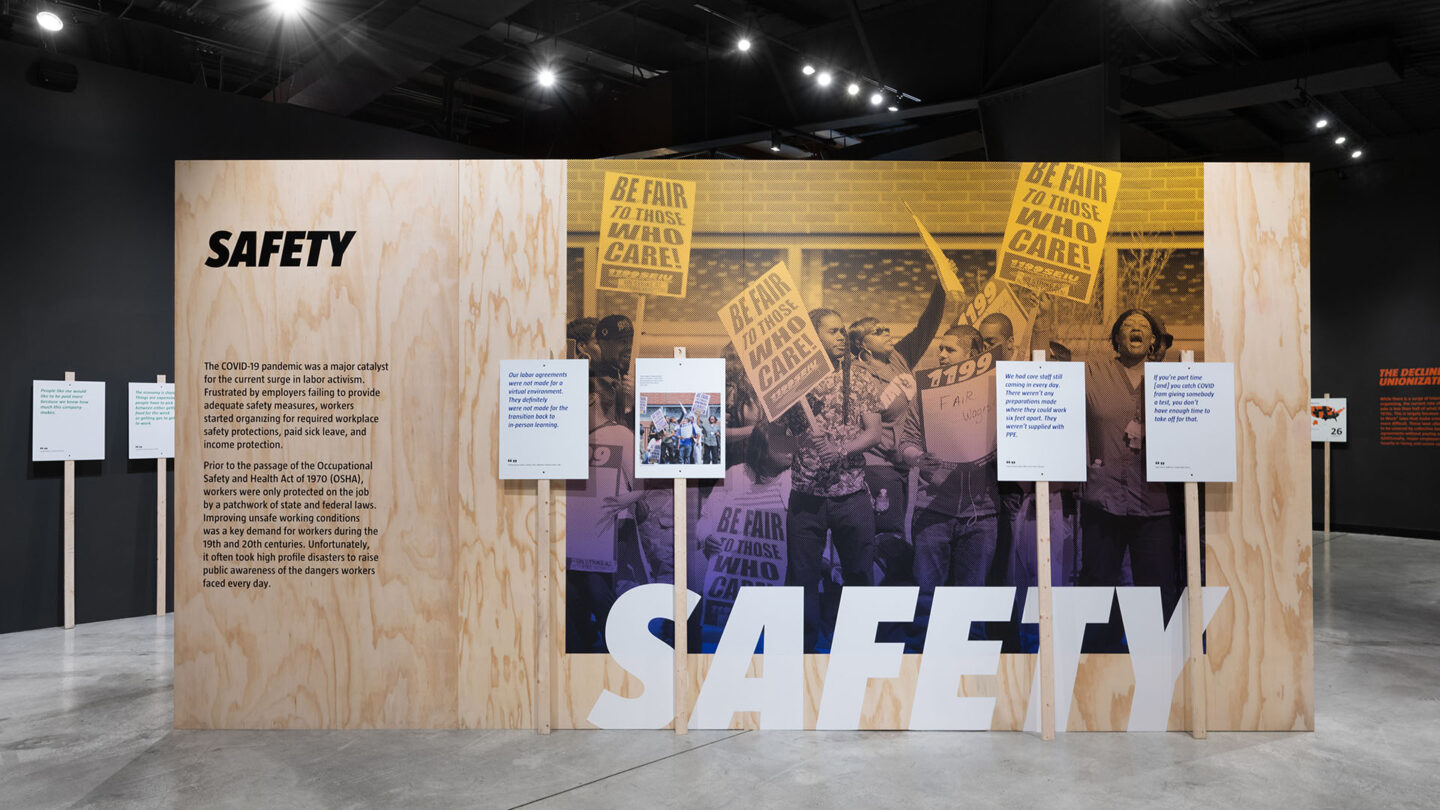
Photography was rendered in true-to-life scale, allowing visitors to stand in solidarity with the advocacy groups. The style also reinforced the immediacy of the subject matter.
Vivian Marie Doering
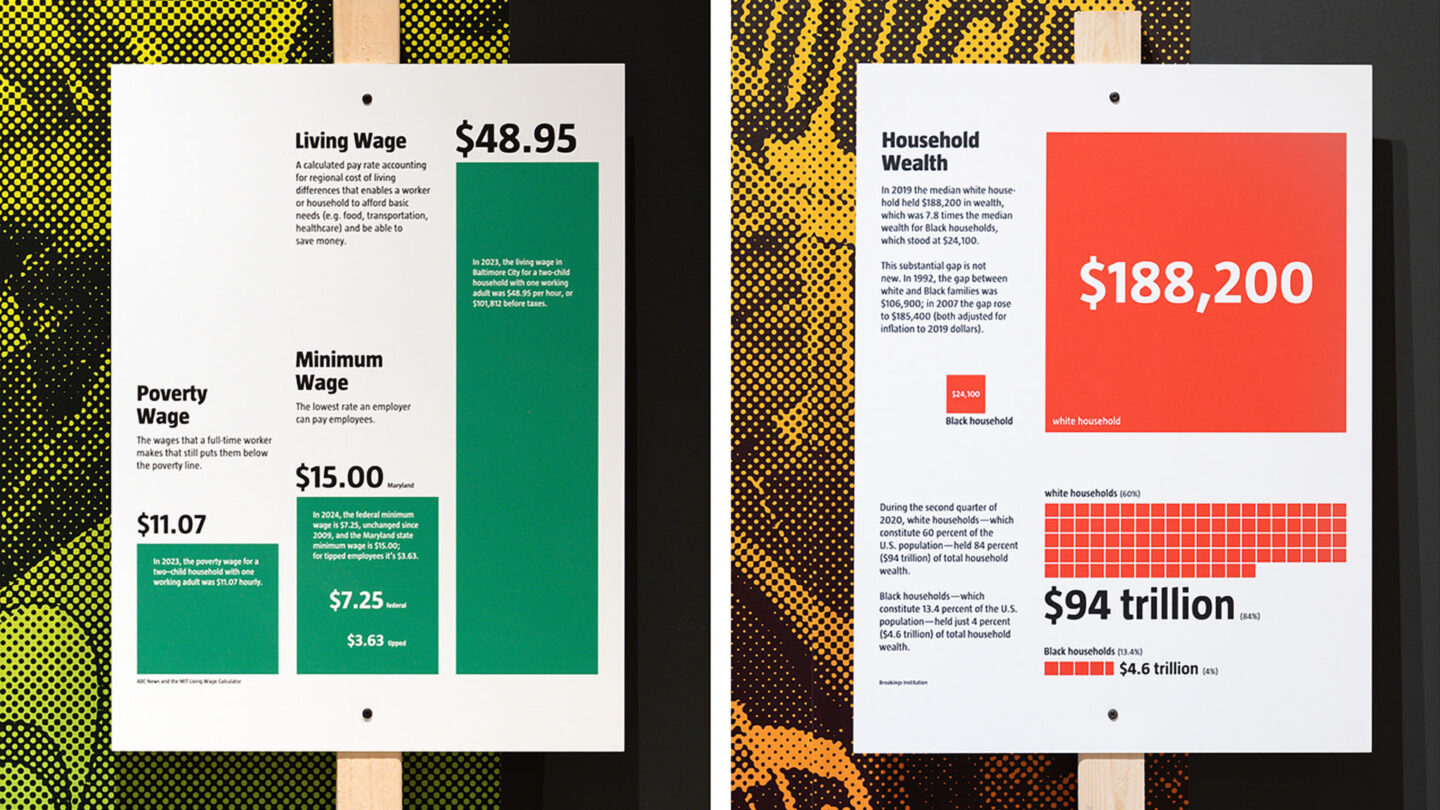
Many of the picket signs presented simplified data graphics to emphasize the stark realities of working in the U.S.
Vivian Marie Doering
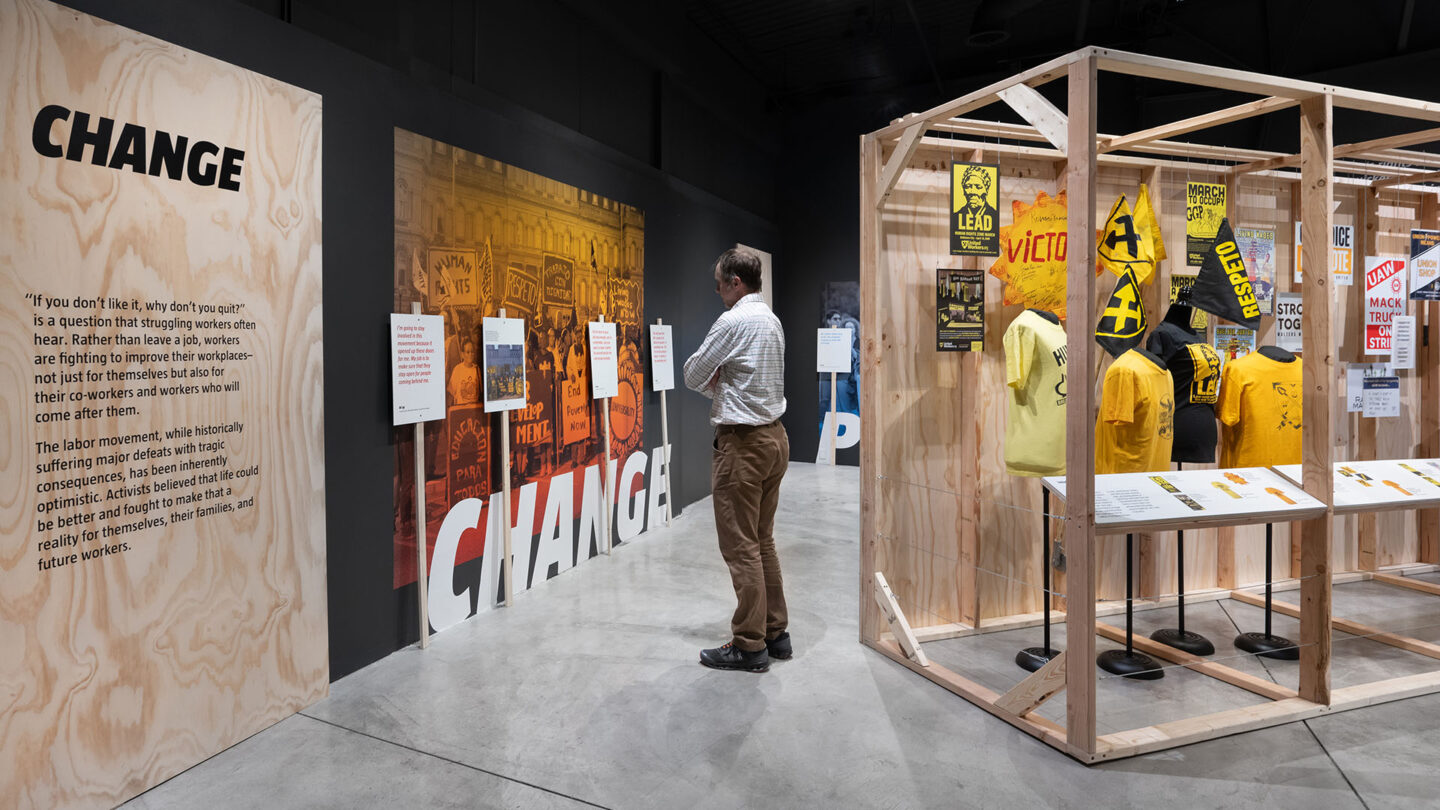
The exhibit was as organized as its subject. The repeated use of plywood, large typography, and bold colors created a consistent visual language that drew visitors further into the experience.
Vivian Marie Doering
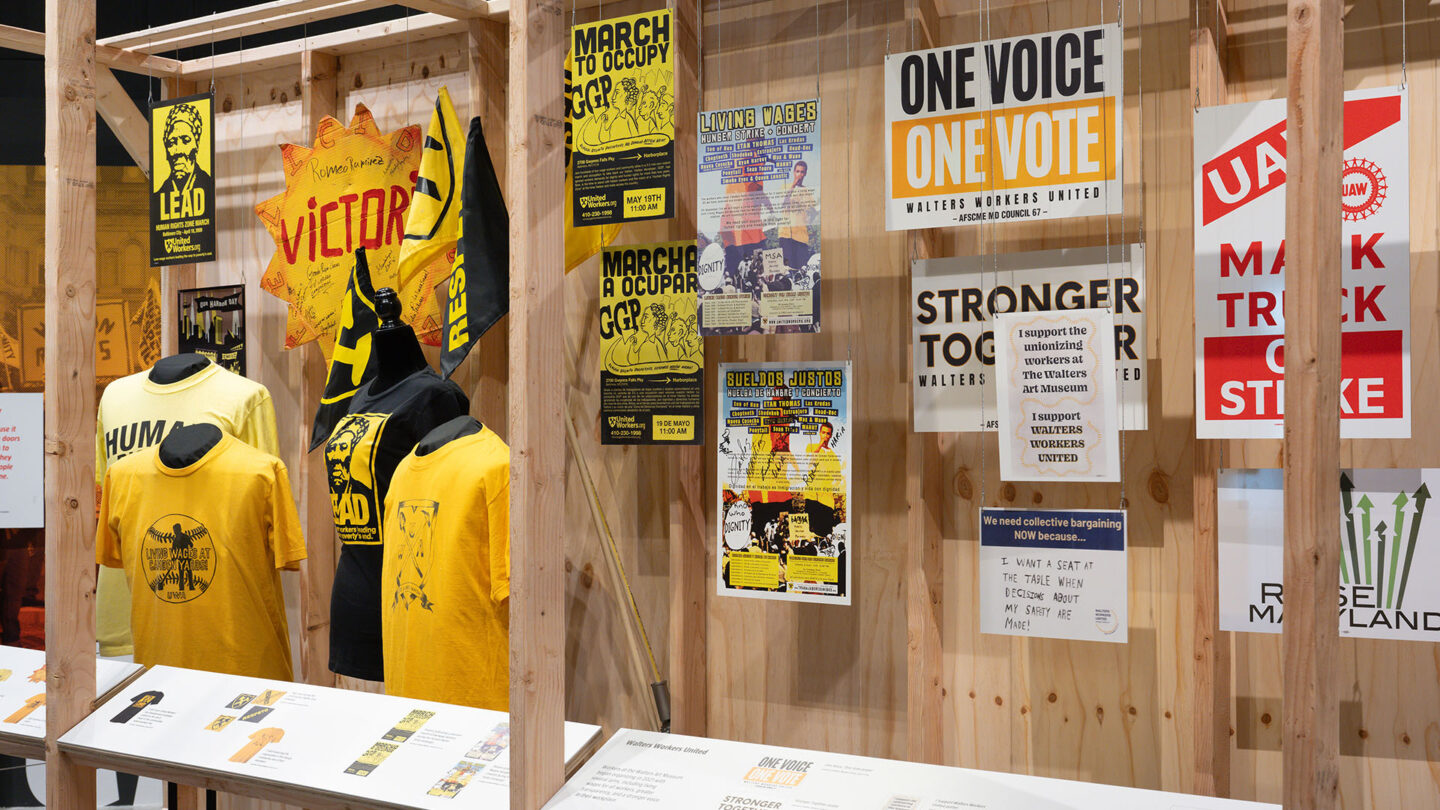
Artifacts and aluminum facsimiles, suspended in the center structure, created a self-contained rally. The three-dimensional collage encouraged visitors to approach it, just as they might a demonstration in real time.
Vivian Marie Doering
Project Details
Design Team
Ashton Design
Photo Credits
Vivian Marie Doering
Open Date
May 2024