Australia Post Support Centre
Australia Post relocated its Victorian location from Melbourne’s CBD to Richmond as part of a strategic shift to cut rent costs and reconnect the company with its core logistics mission. Australia Post occupy 8 floors, approx. 24,000 square meters, of the 11-story building. The new 24,000-square-meter office, named a “support office” rather than HQ, features an open-plan, industrial design to reflect the frontline workforce where even the CEO sits among employees. The design, led by interiors architects, embraces a “homely warehouse” aesthetic with exposed brick, recycled materials, and state-of-the-art technology, including automated booking and hearing augmentation systems.
The Challenge
The primary objective of this project was to design and manage the complete signage and wayfinding for Australia Post’s new support centre in Melbourne’s rapidly evolving inner-urban industrial precinct around Richmond and Burnley.
The challenge was to uphold the integrity of Australia Post’s well-established brand in the built environment, while creating a functional and aesthetically pleasing space for employees.
Project Vision
The primary objective of this project was to design and manage the complete signage and wayfinding for Australia Post’s new support centre in Melbourne’s rapidly evolving inner-urban industrial precinct around Richmond.

Australia Post logo seat clad in discarded print collateral creates a large tactile and interactive brand moment upon arrival, that is visible through the ceiling void from the floor above.
Louis Trerise

Multiple informal meeting ‘boxes’ are scattered along a central ‘conveyor’ with over-sized packaging icons, floor markings, and wall graphics adding to the warehouse narrative of the Support Centre.
Dan Pike
Design + Execution
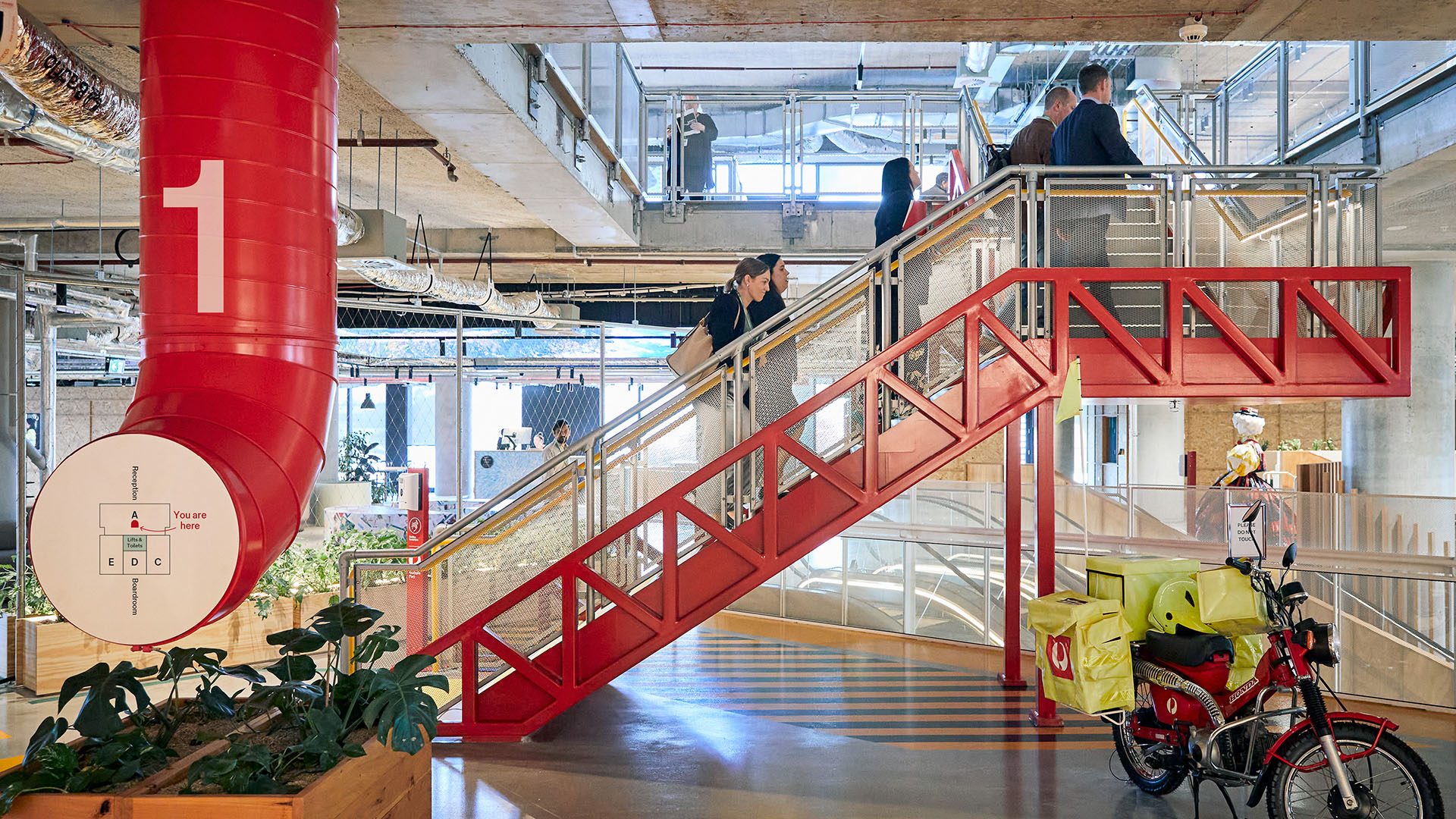
The team worked closely with the interiors architect to ensure a cohesive design approach. In the initial strategic phase, we defined a state-based postcode system to correspond with respective levels, such as VIC 3000 for Level 3. This narrative was further developed to include numerical floor graphics, and room numbering and naming, all referencing Australian suburbs as key components of the postal network.
The building’s strong sustainability credentials were a significant focus of the project. They ensured that the signage responded with environmentally friendly materials, including the use of SaveBoard, a new recycled material made from upcycled packaging, as the base substrate for the suite of sign panels.
The interiors architect’s design driver was to create a down-to-earth support centre that pays homage to Australia Post warehouses and distribution centres across the country. The team responded with a suite of visual references that highlight how the postal system connects the country. Themes of connection and collaboration were incorporated into the reception area, where we conceived a cocooning seat in the shape of the familiar Australia Post logo, which was delivered as part of the artwork commission.
Additional thematic signage throughout the building included postage labels for room panels, warehouse-scale zone and storage coding, and directional floor graphics on polished concrete. Playful elements, such as large tubes reminiscent of ventilation ducts and pneumatic message delivery systems were used to connect paired work floors and visually display floor plans at arrival points.

Meeting room labels reference the distinctive addressing labels of Australia Post, printed onto saveBOARD panels made from post-consumer waste, with signage aligning with the low-carbon materials palette across the fitout.
Louis Trerise
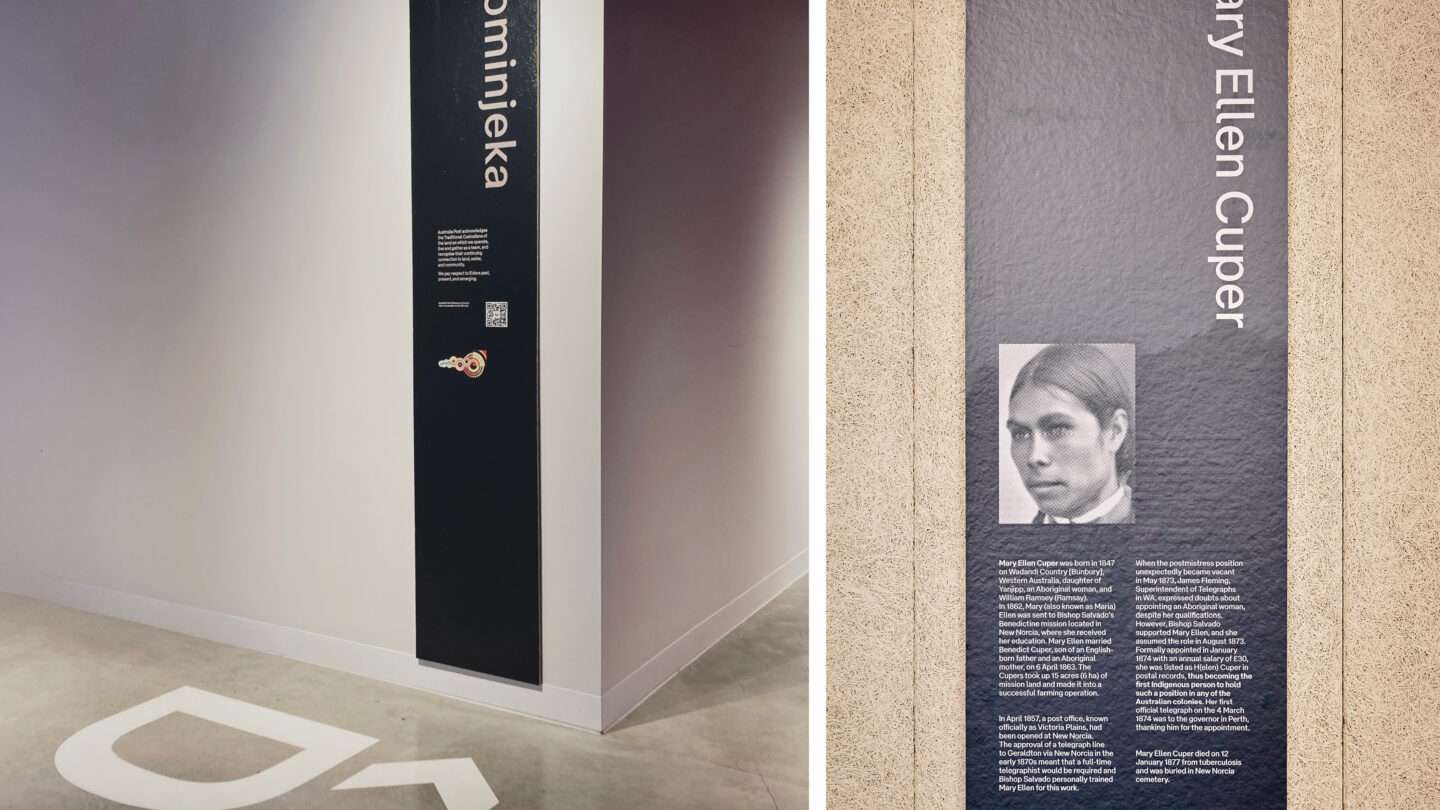
Interpretive content throughout the fitout was also applied to savveBOARD panels, using an alternate colour palette to the wayfinding signage to differentiate the messaging.
Dan Pike & Louis Trerise

Floorplates were divided into zones, with these zones referenced throughout the room, locker, and desk numbering, applied direct to wall and floor substrates, in keeping with the project’s pared-back aesthetic.
Louis Trerise & Dan Pike
Sustainability
Sustainability and circularity were a core consideration throughout the project. Our use of recycled materials, such as saveBOARD and low-impact materials, demonstrated a commitment to reducing environmental impact. These efforts not only contributed to the building’s sustainability credentials but also showcased how innovative design solutions can support environmental goals.
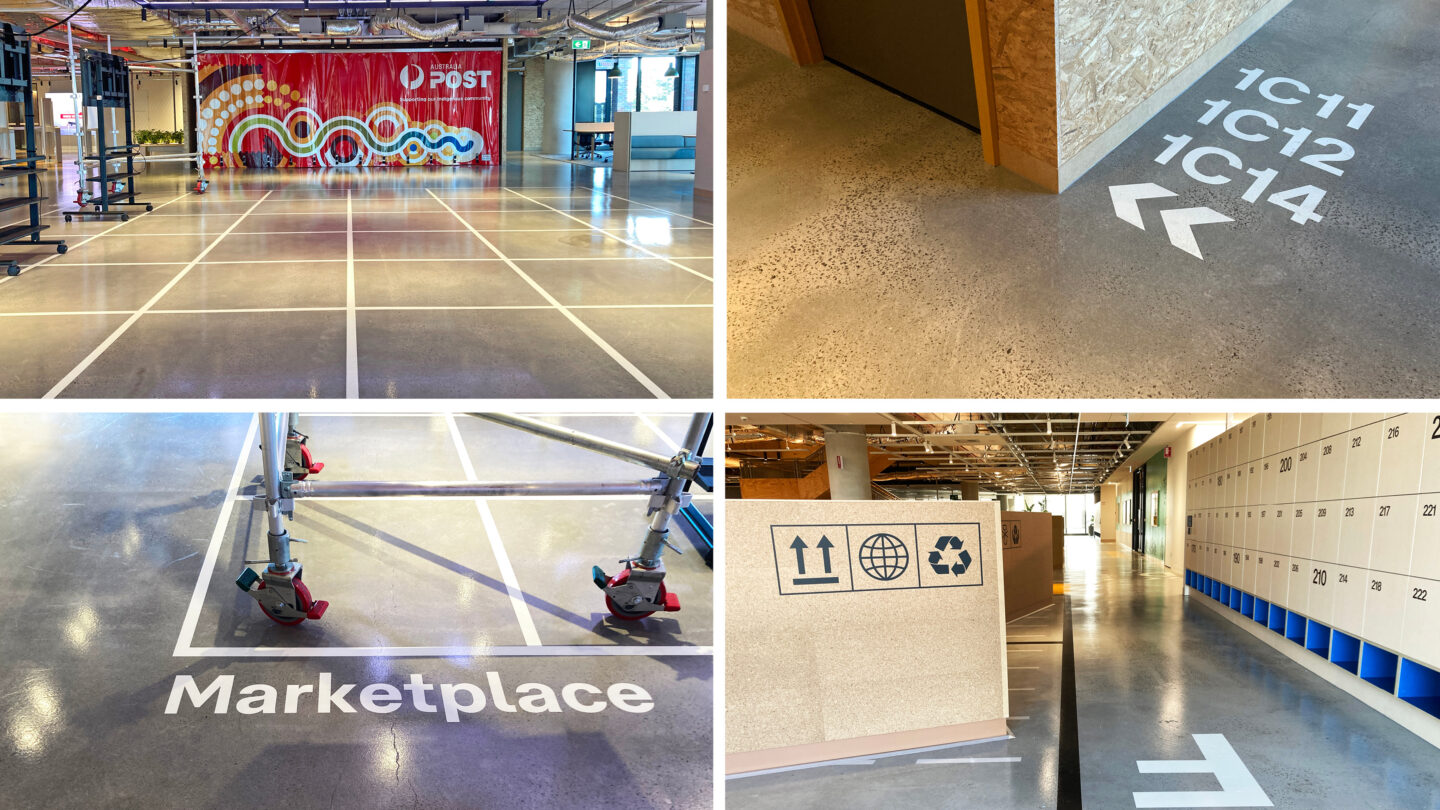
With bold floor markings implemented across the fitout, the signage responded to this approach, integrating descriptive and directional content with respective elements.
Dan Pike


Project Details
The notion that a government office would have the vision to incorporate this much experiential graphic cleverness is amazing. If only all government offices could be this well done.
The creative use of the brand logo within the bench is a successful and unexpected design choice. This project also excels in its thoughtful representation of cultural elements.
This industrial-inspired, visually engaging program employs an information system highlighting how the postal system connects the country. The postal code nomenclature is used as the basis for the wayfinding. The level designation, room number, and room names reference key components for the postal network. This solution is wholly specific and unique to the work of the Australian Post. The industrial aesthetic upholds Australian Post’s brand and connects the “office workers” with the frontline workforce.
Design Team
Dan Pike (design lead)
Todd Dawson (technical lead)
Beth Shipperlee (environmental wall graphics)
Hayley Blick (senior design manager)
Collaborators
Hassell (architecture firm, interiors landscaping)
BB Arch COX (lead designer, interior design)
Intersign Pty Ltd (external entry and sky signage – built)
BUILDCORP (corporate window film company)
ARUP (faction consulting)
United Make (faction consulting)
Slattery (faction consulting)
Photo Credits
Louis Trerise, Dan Pike
Open Date
September 2024
More in Wayfinding
All Projects-
Read more Forest Reflections
Forest Reflections
Mijksenaar -
Read more Muskoka Lumber Community Centre
Muskoka Lumber Community Centre
MJMA Architecture & Design -
Read more Desa Potato Head

Desa Potato Head
Studio Ongarato