Designing for the Unknown: Reflections from 2026 SEGD Xlab
What happens when designers stop searching for certainty and start making meaning? Our reflections from 2026 SEGD Xlab at BRIC in Brooklyn explore the ideas, conversations, and moments that continue to shape how we think about the future of design.
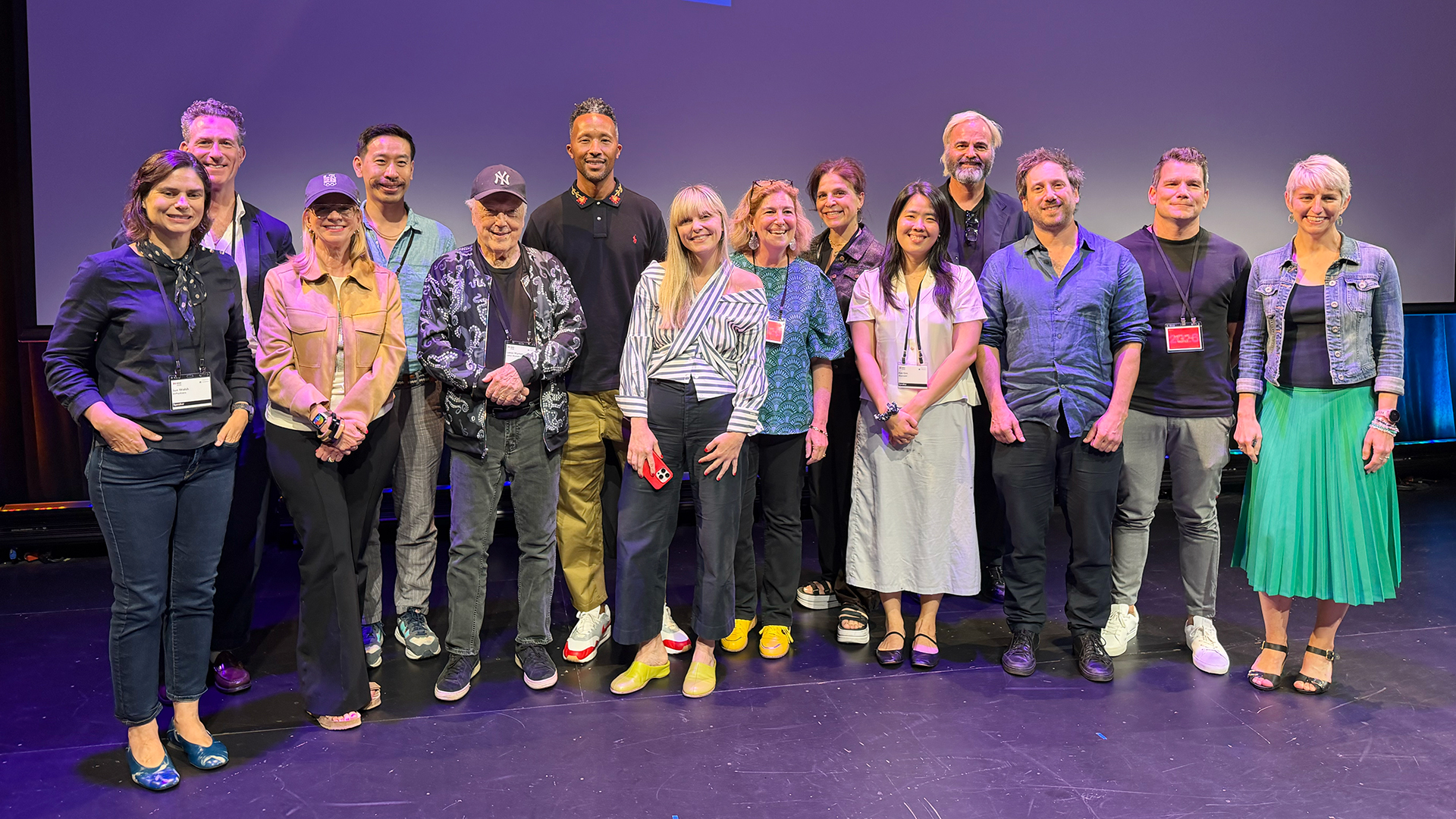
There was no shortage of uncertainty at last week’s SEGD Xlab.
But rather than offering predictions about what comes next, speakers returned to a more fundamental question:
Who do we become as designers when the future refuses to be predictable?
Held at BRIC in Brooklyn following a day of special tours of a few bespoke New York City and Brooklyn creative spaces and an opening reception at Microsoft Garage, Xlab unfolded less like a conference than an ongoing conversation. Across discussions of AI, authorship, empathy, cultural memory, and creativity itself, one idea kept resurfacing: when certainty disappears, attention matters even more.
Leslie Wolke, founder of Mapwell, opened the day by reminding attendees that the “X” in Xlab has always been a variable for 15 years—a space to explore whatever lies at the intersection of design and technology. If there is another “X marks the spot” moment, she suggested, it is the one we’re living through now.
Why We Create
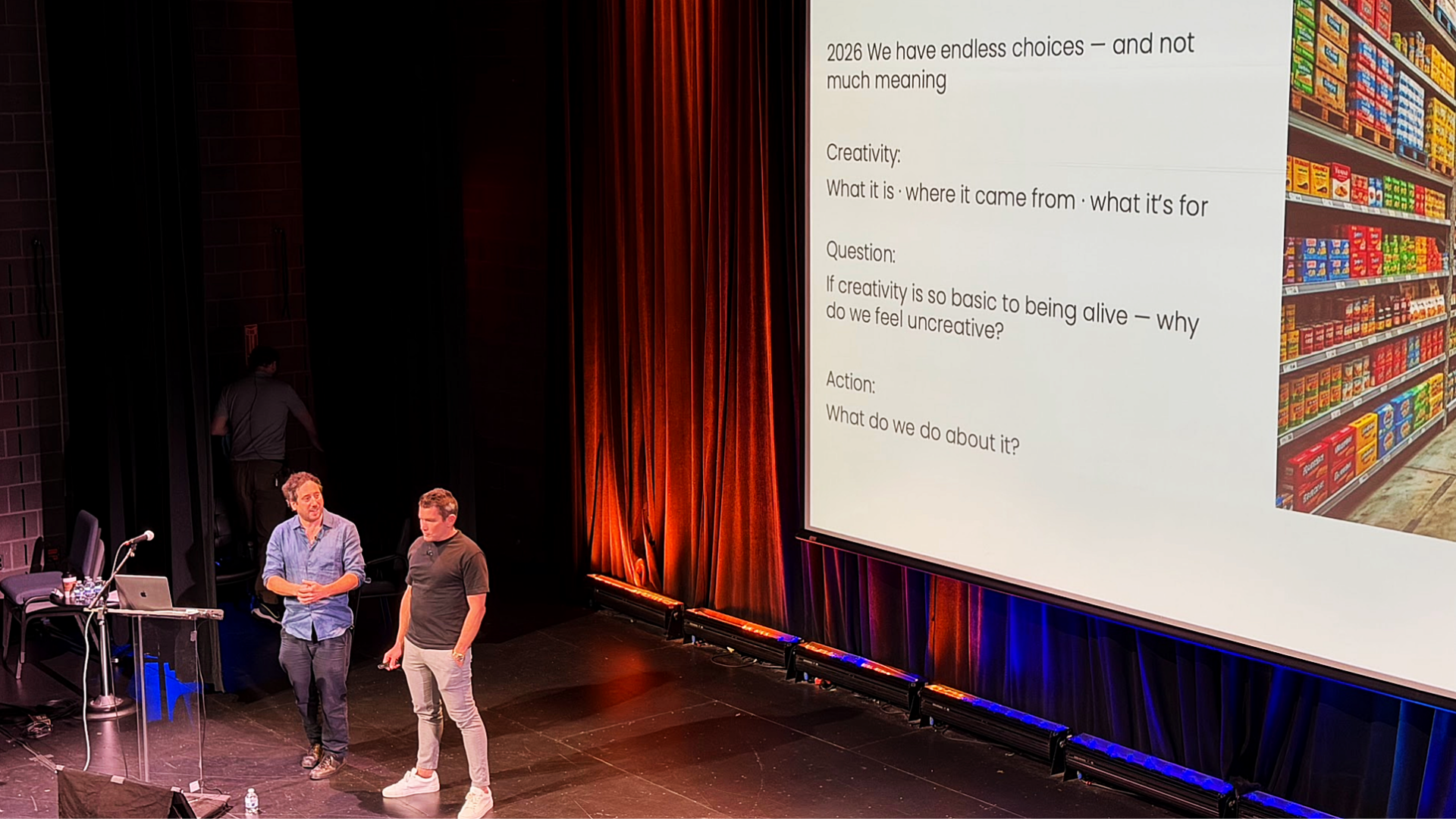
Dave Sheinkopf and Wilson Brown grounded the day in a simple but profound idea: “Creativity is how humans solve problems they’ve never seen before.”
Creativity, they argued, isn’t merely artistic expression. It’s one of humanity’s oldest survival skills. Yet in an age of endless tools, algorithms, and mediated experiences, many of us feel less creative than ever.
By inviting participants to set technology aside—even briefly—and return to paper, pen, and conversation, they reminded the audience that creativity begins not with software, but with attention.
Holding Multiple Truths
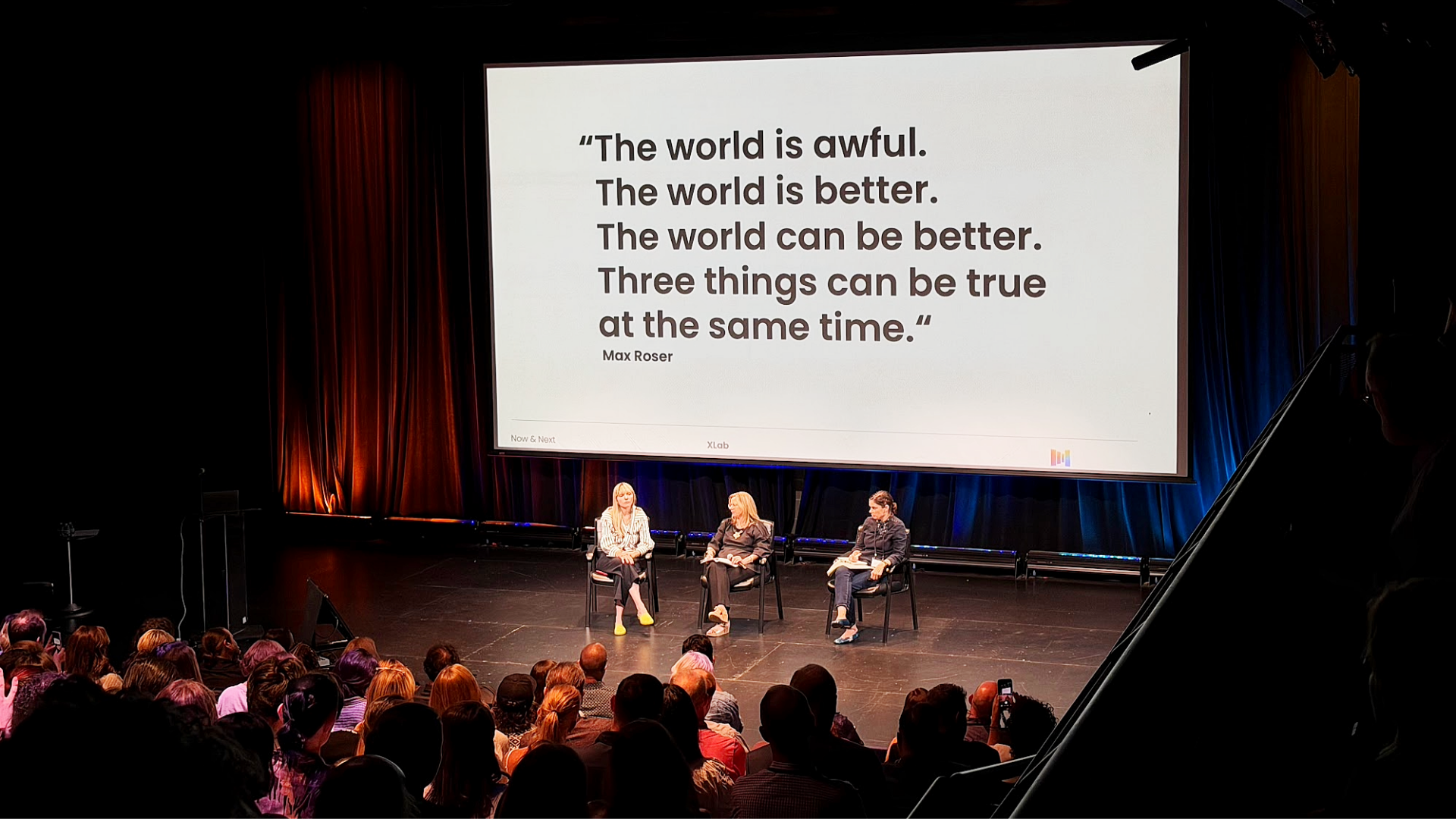
Sue Walsh and Ashley Lukasik shifted the conversation from creativity to the conditions designers are creating within. Nearly half of Americans feel unseen. Most feel they have little ability to influence their future. As uncertainty becomes the defining condition of modern life, our nervous systems—and our imagination—are increasingly under strain.
Against that backdrop, Walsh posed the question that lingered throughout the day: “There’s such a deep relationship now between designers and companies. So we have to ask ourselves: are we designing for people or capital?”
Rather than offering easy answers, they challenged the audience to sit with complexity, as shown in the image above: “As designers, how can we hold these three truths at once? How can we make change?”
Their presentation became a call to reclaim design’s original purpose. As Walsh reflected afterward: “That is the power of design: to help us understand the world, to create different ways of seeing and new possibilities on the horizon.”
Following the Weird
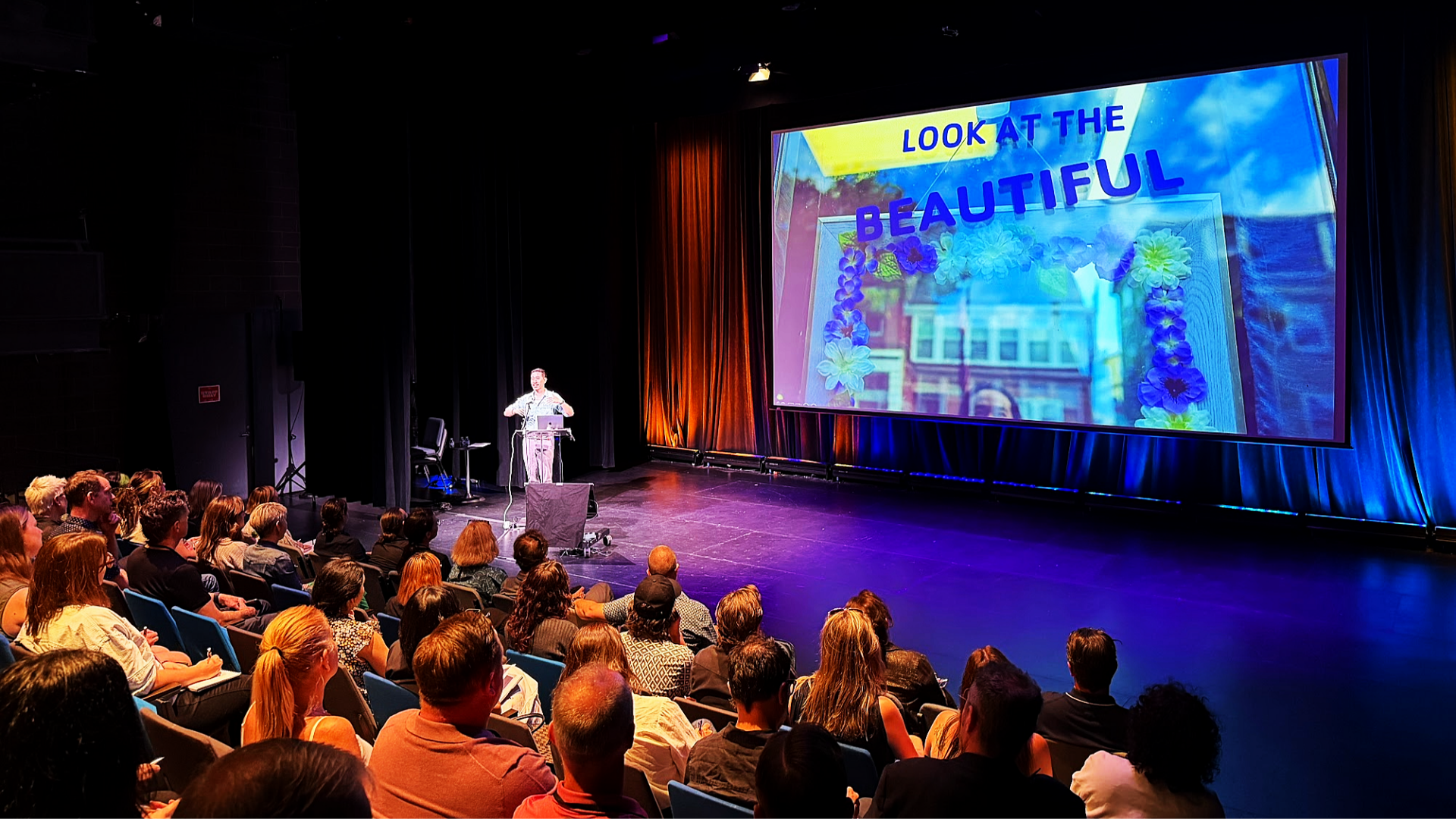
Lee-Sean Huang made the case that creativity isn’t something we force. It’s something we notice. Quoting Rick Rubin, he suggested that “there’s a time for certain ideas to arrive, and they find a way to express themselves through us.”
Through stories spanning improv, teaching, AI experiments, and what he affectionately called the “Ghost Book Incident,” he argued that meaningful innovation rarely comes from optimizing what’s expected. It emerges by following the unexpected.
His invitations were refreshingly simple: “If X, Then What?” “Give Gifts.” “Look at the Beautiful.”
In a world increasingly optimized for efficiency, they felt almost radical.
The Stories We Choose to Keep
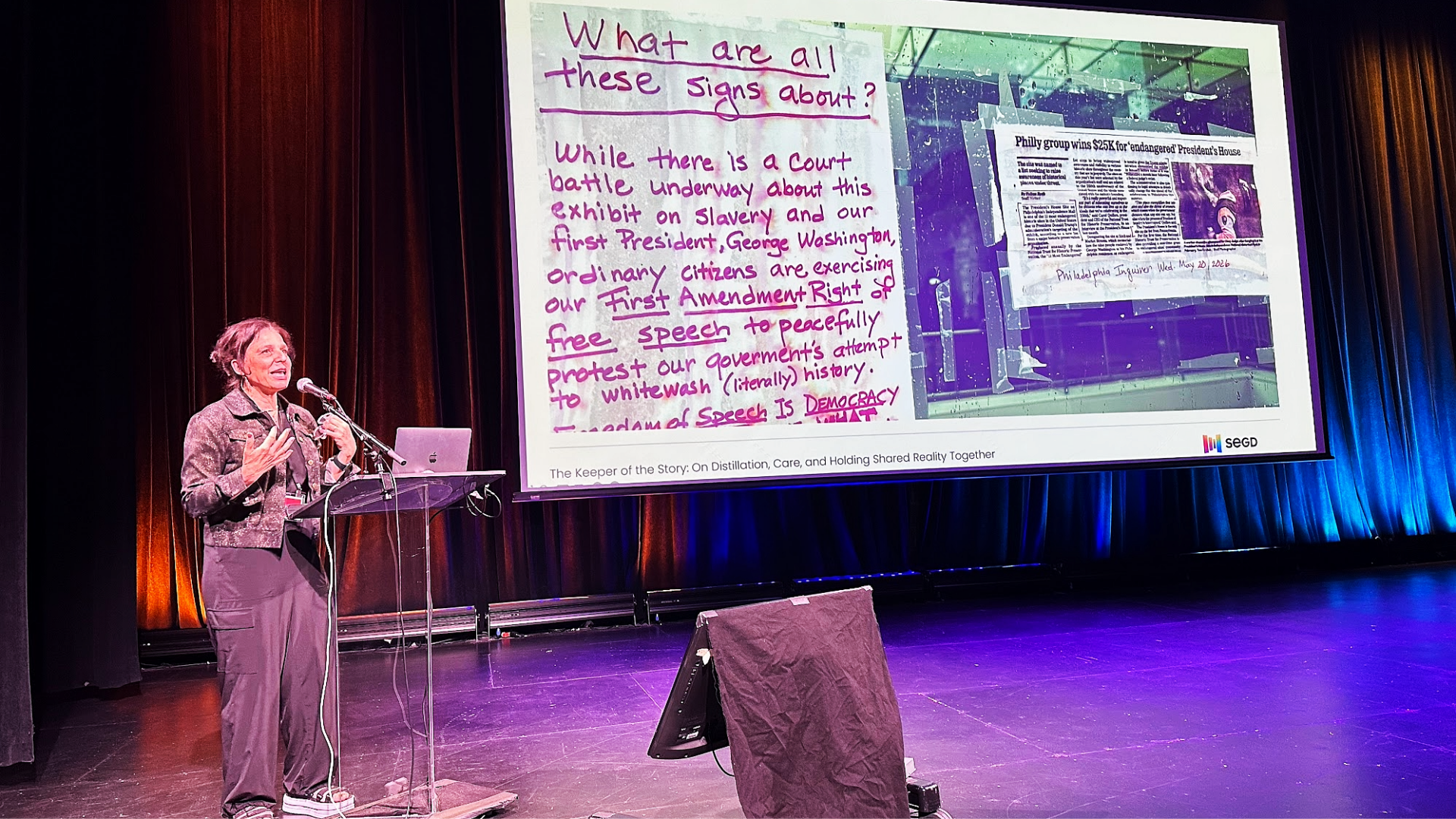
Lee-Sean Huang invited the audience to follow the weird. Eve Moros Ortega reminded them to protect what matters.
“What’s at stake is real,” she reminded the audience. At a moment when public narratives are increasingly contested, museums, exhibitions, and public spaces don’t simply preserve history. They actively shape collective memory.
The suppression of stories, she warned, “and the need to strengthen resistance to that suppression, is very real.” Her call wasn’t simply to tell stories. It was to support the organizations doing this work, organize collectively, and ensure communities can recognize themselves within the stories being told.
Holding Creative Tension
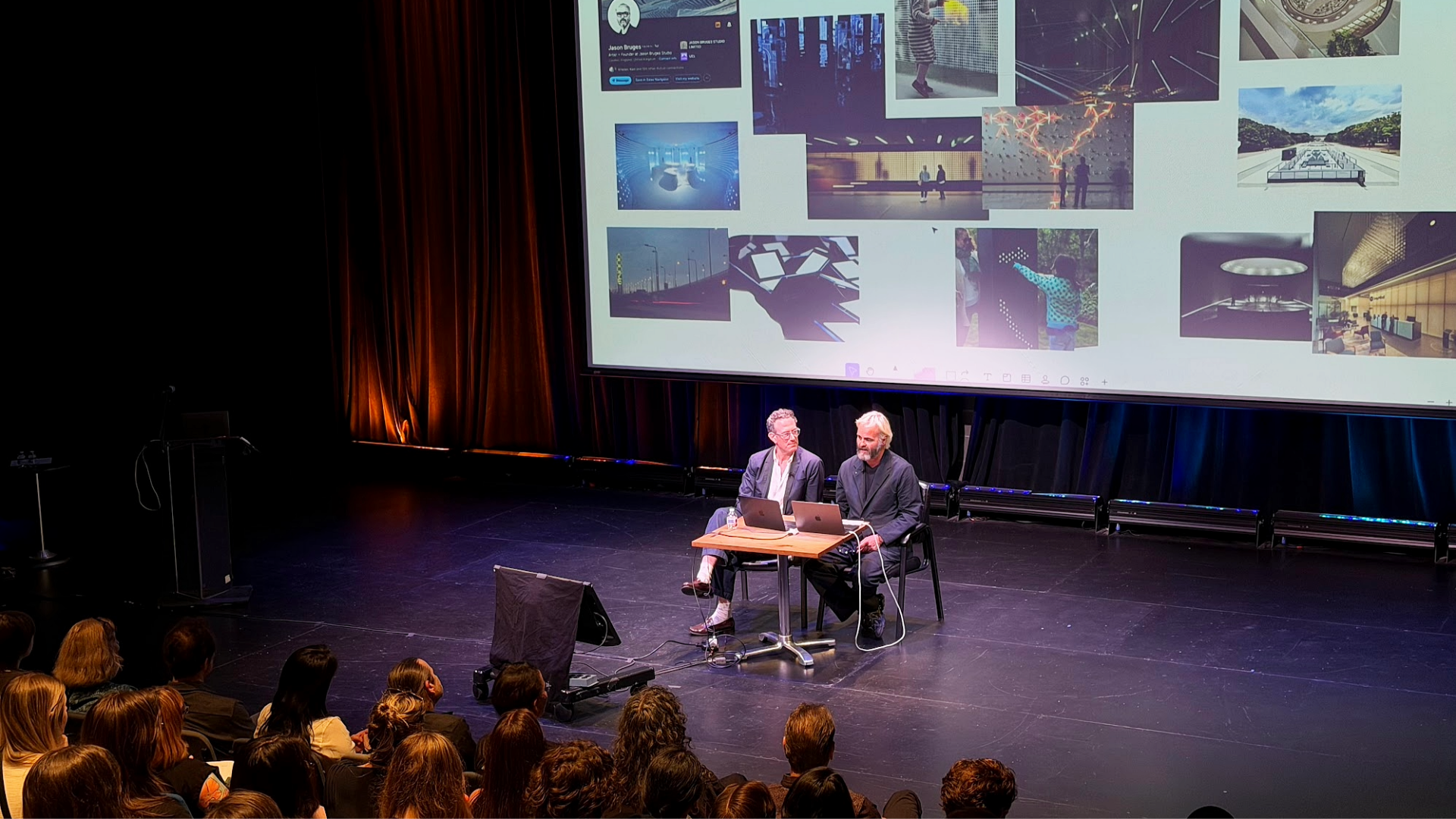
Jason Bruges and David Schwarz abandoned the polished keynote altogether.
Their “anti-presentation” unfolded as an unscripted conversation around a sprawling FigJam board filled with sketches, references, images, and half-formed ideas. Rather than guiding the audience toward a single conclusion, they invited everyone into the associative thinking behind more than two decades of practice. They gave a “peak under the hood” of their divergent work processes, with Jason moving towards physical prototypes and mockups near the onset of a project and David and team creating endless stickies and iterative sketches before committing to a physical manifestation.
At one point, Schwarz distilled years of experimentation into a single sentence: “More is more internally. Less is more externally.”
Behind every seemingly effortless experience lies countless iterations, discarded ideas, and creative detours. As one attendee later remarked, it felt “like being in both of your heads.”
Productive Struggle
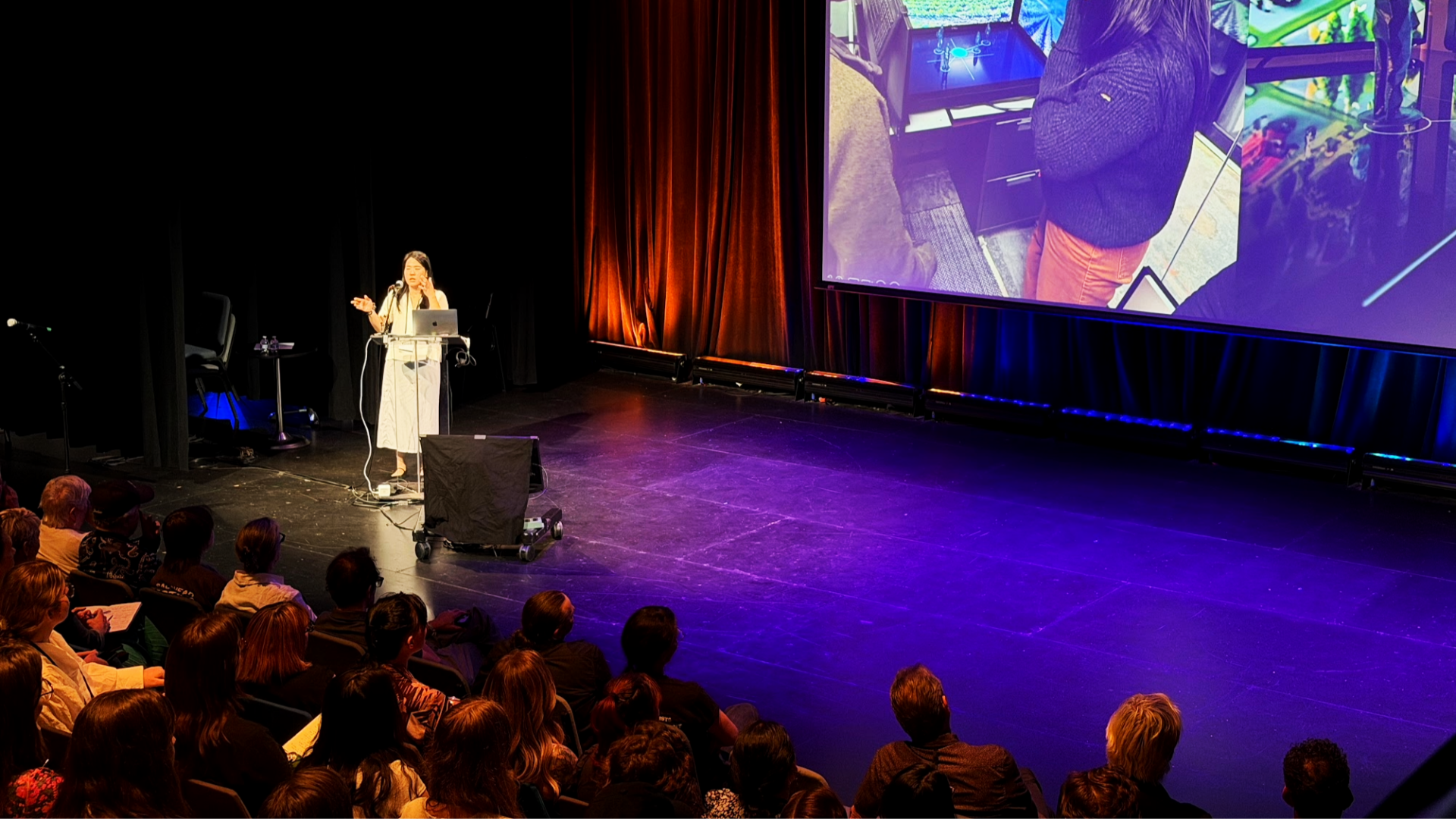
Kim Gim continued that thread through Bluecadet’s work with Boston’s Museum of Science. The institution’s philosophy is simple: “Learners don’t learn in comfort.” That idea of productive struggle became more than a learning principle. It became the foundation of the design process itself.
By embracing uncertainty instead of rushing toward certainty, her team built deeper trust with their client, strengthened collaboration, and ultimately created better work. Sometimes uncertainty isn’t a problem to solve.
It’s the process itself.
Reframing the Future
Julie Maggos suggested that AI isn’t primarily a technology problem.
It’s a meaning problem.
Drawing on her own experience navigating cancer treatment, she showed: How we frame something changes how we engage with it.
Reframing chemotherapy from “toxic chemicals” to a “magic elixir” became a powerful metaphor for how designers might approach AI itself.
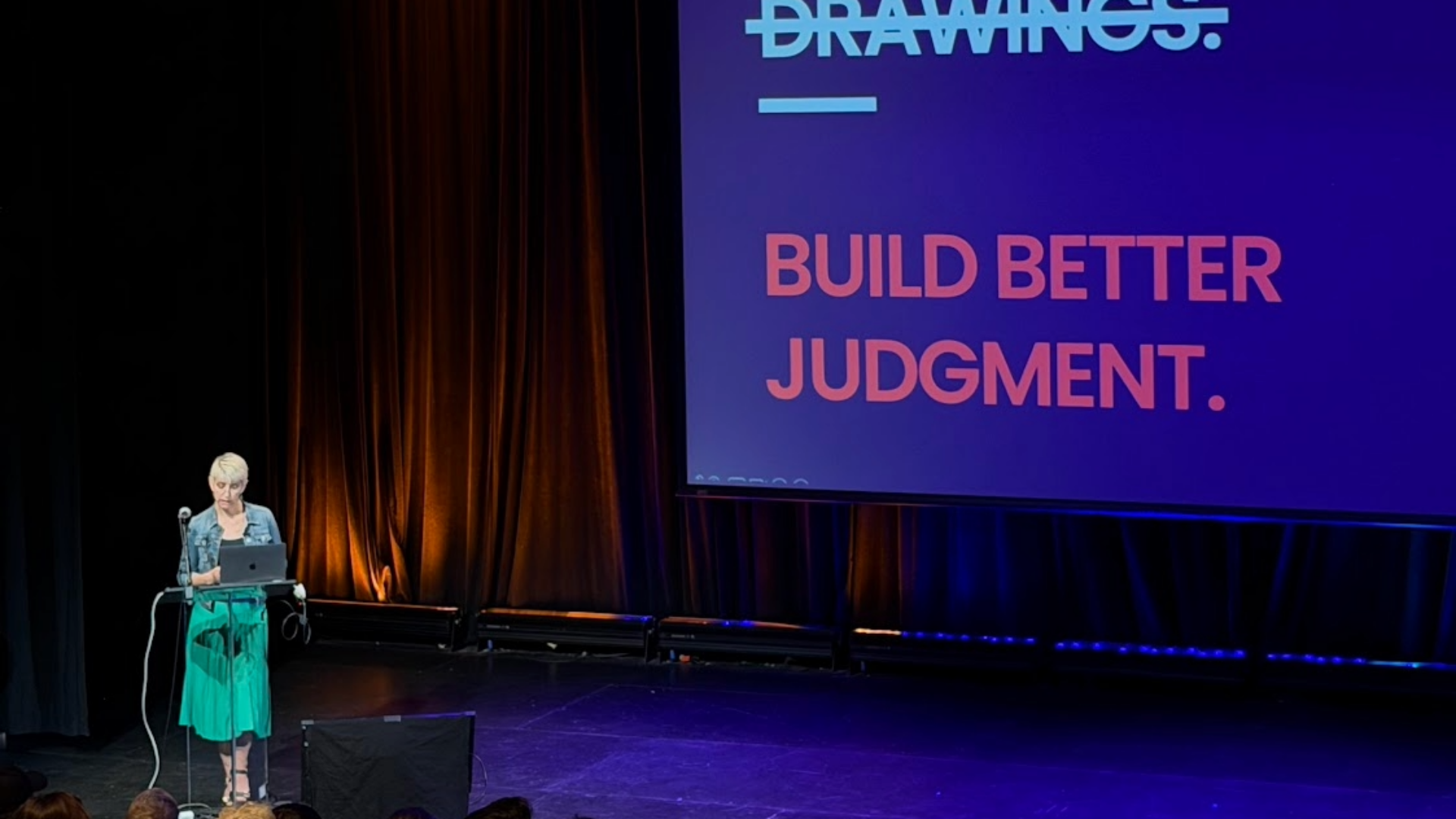
Quoting Ethan Mollick, she reminded the audience that “AI generates, but it does not intend.” As information becomes abundant, judgment becomes increasingly valuable. Or, as she put it, “When tools automate production, the apprenticeship isn’t to do more drawings. It’s to build better judgment.”
The future designer’s job isn’t simply producing more work. It’s asking better questions, exercising better judgment, and helping others navigate ambiguity.
Design That Outlasts the Moment
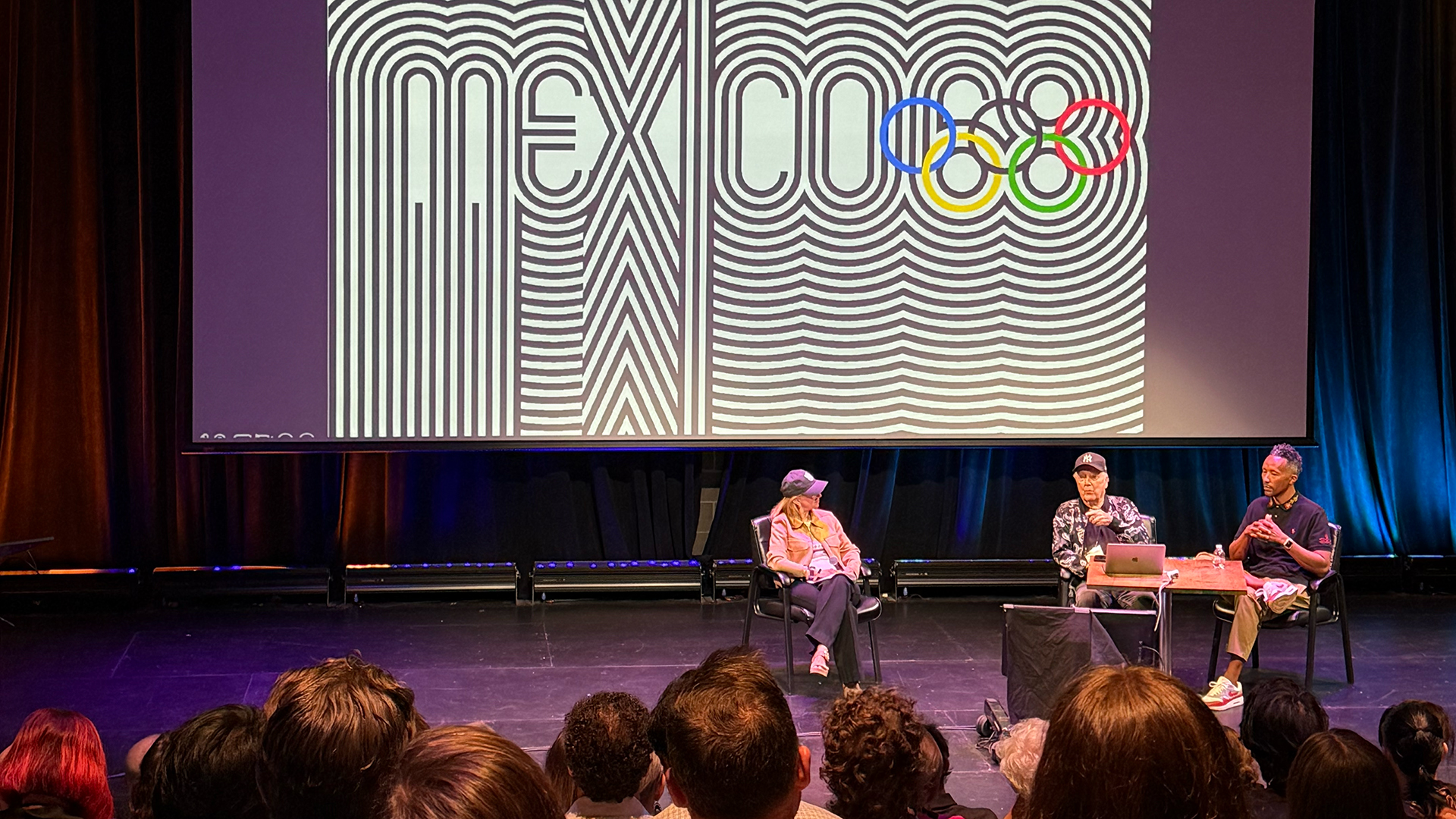
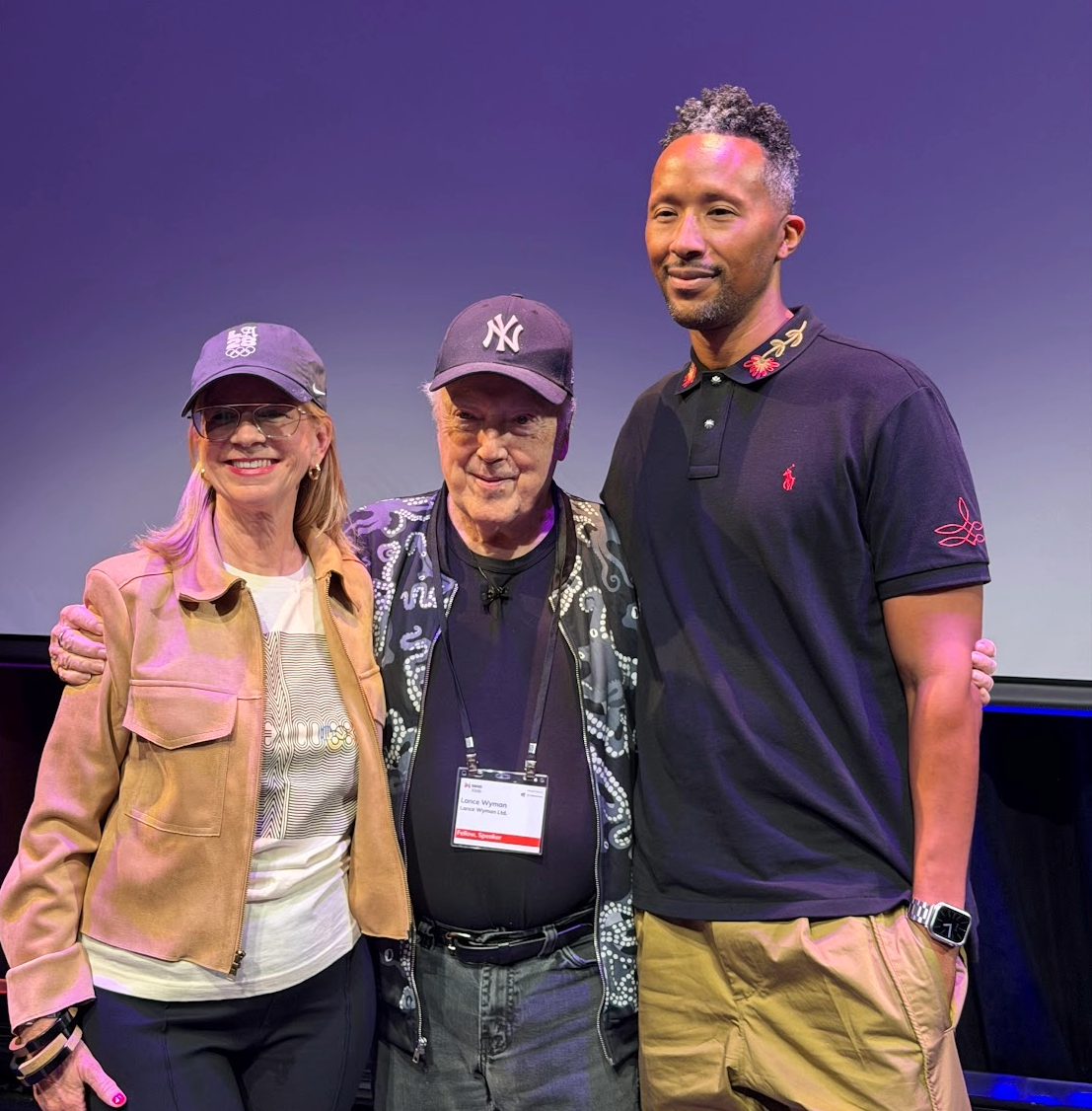
The closing conversation between Lance Wyman and Ric Edwards wasn’t simply about two Olympic identities separated by sixty years. It was about curiosity, cultural immersion, and the kind of work that continues to resonate long after it’s enters the world.
At 29, Wyman, his business partner, and his new wife boarded a one-way flight to Mexico City to interview for the design team behind the 1968 Olympic Games. Once there, he realized he couldn’t design for a culture he didn’t yet understand. Before putting pencil to paper, he immersed himself in Mexico’s museums, archaeology, architecture, and visual traditions. With his trusted drafting compass always nearby, he explored the geometry of the Olympic rings alongside the patterns and forms he encountered throughout Mexico.
The breakthrough came through that process of discovery. As Wyman recalled, “I was lucky enough to realize that Pierre de Coubertin’s geometry could be extended into the year of the event… We knew we had something because there were a lot of examples in those early cultures where geometry was really important.” The resulting identity became one of the most influential in design history because it grew from the culture itself, rather than simply being applied to it.
Decades later, Wyman still delights in discovering new echoes of that work. He laughed about mistaking an early Apple iPod billboard for his own because its colorful dancing silhouettes so closely resembled the iconic athlete graphics from Mexico ’68. These weren’t stories about imitation. They were stories about design becoming part of our shared visual language.
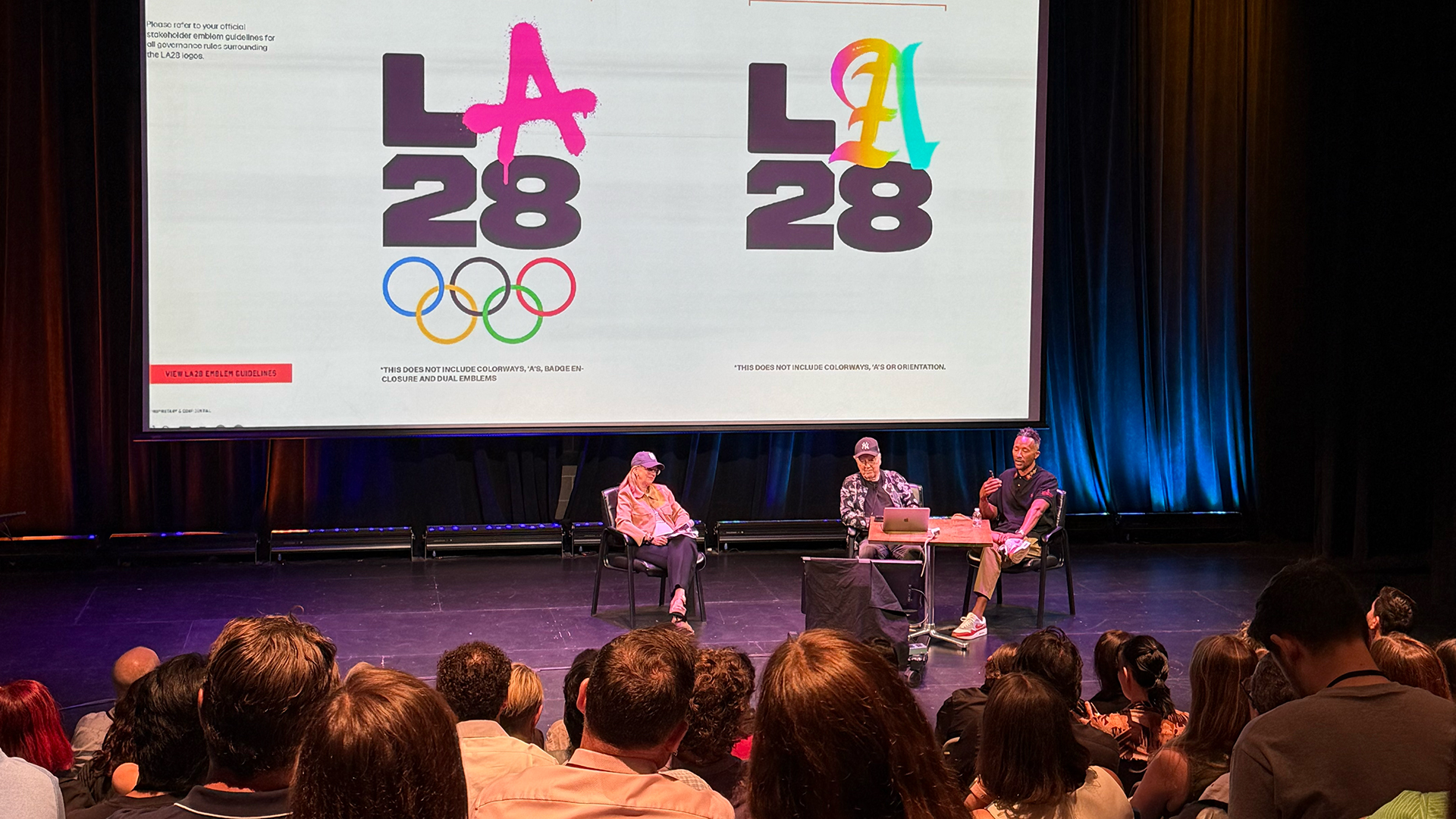
Edwards revealed that the same philosophy intentionally shaped the identity for the LA28 Olympic and Paralympic Games. Rather than searching for a single visual style, his team embraced the many layers of Los Angeles—from graffiti and vernacular lettering to entertainment, neighborhoods, and the city’s rich cultural history. Even the typography became an expression of those overlapping influences. Nature offered its own moment of serendipity: the identity drew inspiration from California’s wildflower blooms, and Southern California experienced a spectacular superbloom just as the design was unveiled.
Rather than creating a fixed logo, the team designed a living identity system whose iconic “A” belongs to the community. Every iteration reflects a different athlete, artist, neighborhood, or cultural voice while remaining unmistakably LA28, adapting seamlessly from merchandise and tickets to stadium-scale graphics.
The most enduring design isn’t something we preserve unchanged. It’s something we create robust enough for others to adopt, reinterpret, and make their own.
That was the thread connecting two generations of Olympic designers. Wyman showed what happens when a visual language becomes part of culture. Edwards demonstrated what it looks like to design for that possibility from the very beginning.
The Thread That Held It Together
Every session approached uncertainty from a different angle.
Some asked us to protect stories. Others urged us to follow curiosity. Some challenged our relationship with AI. Others reminded us that trust is built by moving through uncertainty together.
Together, they arrived at the same conclusion.
The designer’s greatest contribution isn’t certainty. It’s helping people make meaning.
Meaning that helps us navigate complexity with empathy. Meaning that invites participation instead of control. Meaning that’s generous enough to be reinterpreted, resilient enough to evolve, and human enough to endure.
That may be the most important work designers can do now.
How It Felt to be in the Room
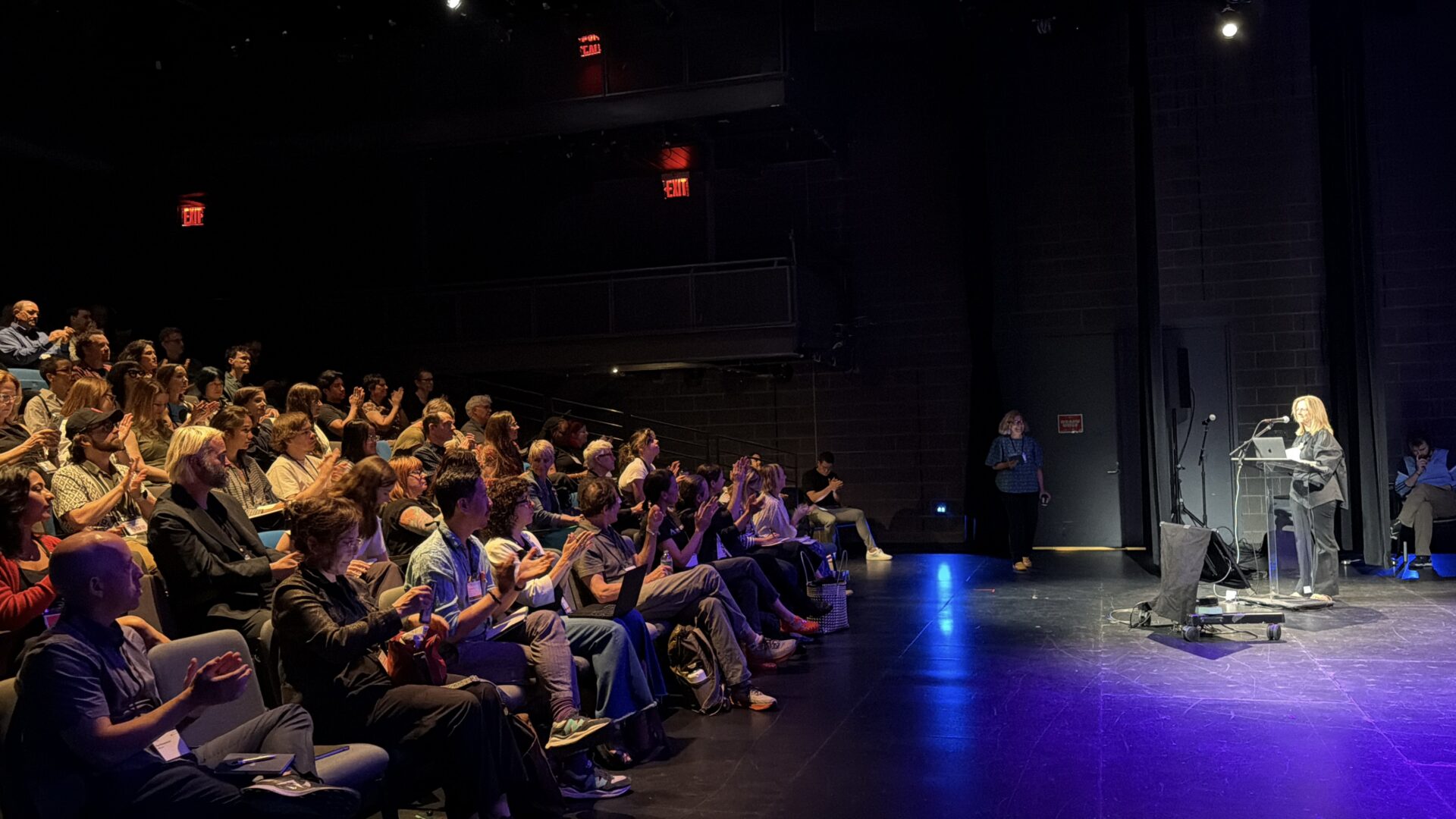
If the sessions explored uncertainty, the conversations afterward revealed why gathering together still matters.
Across LinkedIn, email, and hallway conversations, attendees—from students attending their first SEGD event to industry veterans—returned to the same themes: curiosity, generosity, hope, and the rare feeling of being part of a community willing to wrestle with difficult questions together.
Here are a few attendee reflections, edited for brevity, that capture the spirit of Xlab.
The output of days like these are new connections, knowledge of the industry, and space for my mind to wander. I've got lots of new ideas, and I'm excited to start executing. Go let your mind wander.
Last week… had the privilege of sharing the stage with Lance (Wyman), meeting his wonderful wife and family, and spending time with a room full of designers chasing the same thing – creating work that transmits something true and pure. At 89 years old, Lance hasn’t slowed down. He’s still shaping the world, including work with Mexico City’s transportation system. That’s a reminder that creativity isn’t a career. It’s a practice. A way of seeing. A lifelong conversation with the world around you. One idea kept following me home – the work people remember isn’t always the most polished or the most expensive. It’s the work that carries an unmistakable signal. You can feel when something has been made from a place of truth. I’ve been thinking a lot about that signal lately. Not just how we design things, but how we learn to recognize what deserves our attention in the first place. That’s a conversation I’m excited to dig in to more deeply over the coming months…
This week I attended my first SEGD Xlab event. What a great event. Interesting conversations with smart, thoughtful designers from early career to seasoned pro. Already looking forward to the next one.
Xlab New York 2026 was my first time attending, and in all honesty, I was not expecting more than a high-level portfolio review. [Instead] There were many more thoughtful conversations about the state of design in an environment ripe with doubt about what design even means in an age where everything is replaceable. I can say with all honesty that it infused me with new hope for us designers, and reminded me that this profession equals responsibility and to shepherd the world we all want to live in, we all must meet the moment with courage and conviction.
Thank you for putting together such an eye-opening event at SEGD XLAB yesterday. It was incredibly helpful as a student navigating the early stages of a career in experiential design. Looking forward to attending more SEGD events in the future.
Thank you…for the invitation to speak at XLab this past Thursday…There is no question that this is a real moment for design. Someone shared, "Wow .. you really took us somewhere … and then brought us back up! ps – As many others have noted, a highlight was to hear Lance Wyman talk about his work on the 1968 Mexico City Olympics. The way he spoke made it all seem … effortless. A lot to learn. What a gift.
Congratulations again on such a fantastic event full of high-quality speakers. Genuinely enjoyed the whole day.
Congratulations on an awesome xLab. What joyful energy! Thanks for all the insights and for pulling a proverbial rabbit out of the proverbial hat… it’s always magical at SEGD.
Thanks for putting together such an inspiring event. How special to celebrate Lance, that was touching.
People also viewed…
-
2026 SEGD Conference Experience Kansas City
2026 SEGD Conference Experience Kansas City
-
Get Out and Get Inspired: Your Guide to the 2026 SEGD Conference Experience Kansas City Tours
Get Out and Get Inspired: Your Guide to the 2026 SEGD Conference Experience Kansas City Tours
-
2026 SEGD Xlab New York
2026 SEGD Xlab New York